

Peek Inside Our Bat-eared Fox Family’s Den

While you wander Great Cats Circle, step onto the path by bat-eared foxes and feast your eyes on our frisky fox kits—the first born at the Smithsonian’s National Zoo in 75 years! In April, first-time parents Ziggy and Lando welcomed two male kits. Now, they’ve emerged from their den and spend these summer days playing games of chase and snuggling in an adorable cuddle puddle. Get to know our bat-eared fox family in this Q&A with Carnivores Curator Craig Saffoe, Assistant Curator Leigh Pitsko and Keeper Sydney Mayers.
UPDATE: As of Aug. 5, keepers have decided on names for the kits: Han and Solo! This article has been updated to reflect the kits' names.

Bat-eared fox father Lando guards the den while his two pups explore the world outside the entrance. (Brett Kuxhausen/Smithsonian)
Why are these kits a big deal for the Zoo?
It's very exciting to have a successful breeding season, especially on the first try! Ziggy came to the Zoo in spring 2025 right before her first birthday, so this is the first season where she was an adult and mature enough to breed. Lando had not been paired with a female prior to Ziggy, so this breeding season was a first for him, too. The fact that we haven’t had bat-eared fox kits at the Zoo since 1951—75 years ago—adds to the excitement as well.

Bat-eared fox parents Ziggy (left) and Lando. (Roshan Patel/Smithsonian)
What are Ziggy and Lando’s personalities like?
Ziggy is confident and a little bossy. When she first arrived, she settled in well and helped Lando (who tends to be a little nervous) gain confidence when interacting with keepers. She may approach things slowly and cautiously, but Ziggy is never too fearful to experience something new.
She also has no issues telling Lando what to do. During her pregnancy, we would often see Ziggy telling Lando to get out of her way—whether that was to allow her to move past him, take his spot in the sun, or tell him to get away from food.
Lando is quick to react to unexpected sounds and movements. Sometimes, he will dramatically run halfway across the habitat! I think that wariness makes him a good, protective dad. He also has a cuddly side. The first time he met Ziggy, he bee-lined straight to her and laid right next to her like he's known her for ages. Now, over a year later, he is often found sitting close to her and, on some occasions, curled up on top of her!

Meet Han and Solo, our bat-eared fox kits! (Roshan Patel/Smithsonian)
What are the kits’ personalities like?
We have 2 male kits, named Han and Solo, and they seem to have different personalities. Han is a little bigger and more brave. He is the first to come over for a treat and will stay out of the den for a longer time. Solo is smaller and more shy. I'm sure their personalities will change over time!

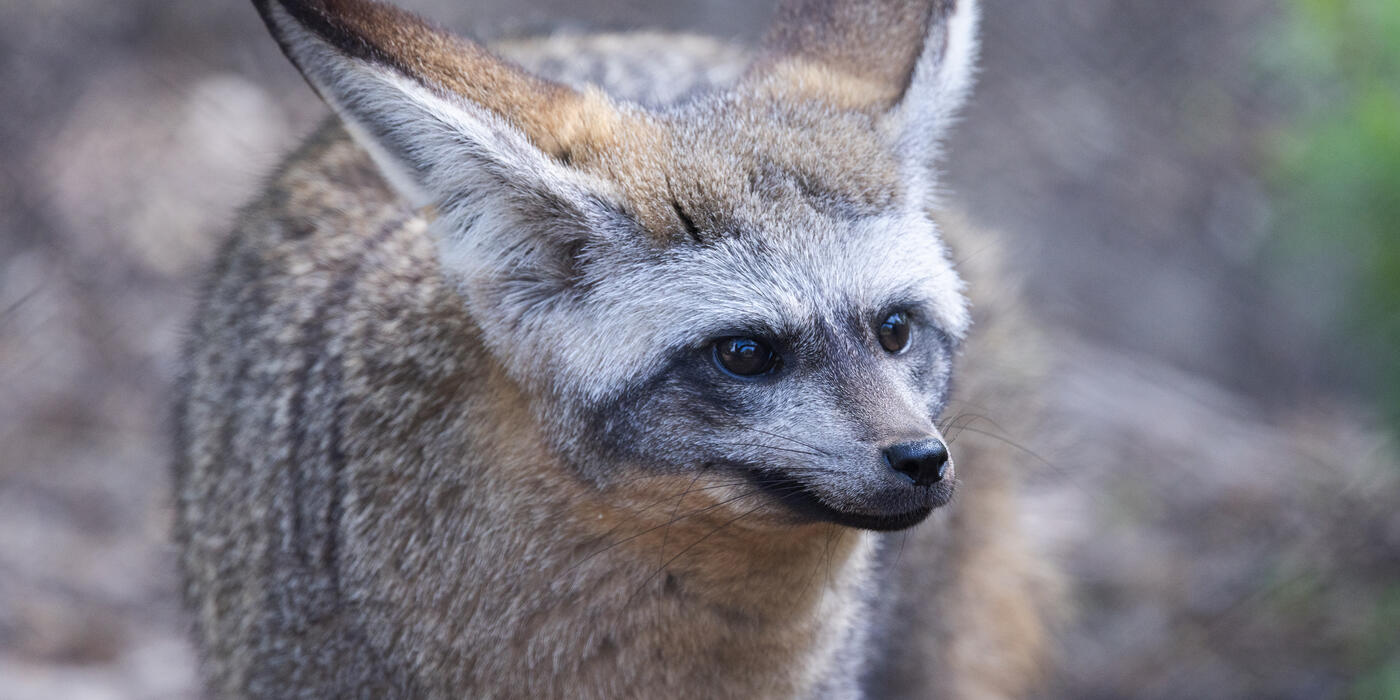
Bat-eared fox Ziggy in "vigilance mode." (Roshan Patel/Smithsonian)
How are Ziggy and Lando adjusting to parenthood?
Ziggy seems to be adjusting to motherhood well, and Lando has adjusted to his dad role quickly and easily. With bat-eared foxes, parenting is a team effort!
Mom's main role is to get enough food for herself so she can produce milk to feed the kits. Dad provides most of the parental care including protecting, defending, grooming and chaperoning the kits. Typically, dad moves the kits between den sites. And he’s also the one that teaches the kits how to find and hunt for food.
Ziggy is alert to potential threats but quickly settles once she sees Lando has it under control. In the first few weeks of the kits’ lives, Lando spent most of his time protecting the entrance to the den or underground with them. In fact, his drastic change in behavior—slipping into “dad mode”—was a strong indication that Ziggy had given birth!
When Han and Solo were newborns, he would do a very thorough check, both visually and auditorily, around him before quickly diving underground. When the foxes are in “vigilance mode” they flatten their huge ears down—it's adorable! You can see Lando doing it when keepers approach behind the exhibit and when he is guarding the den.

(Roshan Patel/Smithsonian)
What made you suspect Ziggy was pregnant and gave birth?
Ziggy and Lando bred in late winter, at bat-eared fox gestation typically lasts between 60 and 70 days. Once we knew she was in her potential birthing window, we paid closer attention to her weekly weights and kept an eye out for behavior changes in both parents.
Ziggy’s appetite was extremely high in early April. We weigh the foxes weekly, and just before giving birth, Ziggy tipped the scales at 5.45 kilograms, or 12 pounds—a big number for this small species! She did not come out of the den to eat on April 27, and when we weighed her on April 29, she was 4.84 kg (10.6 pounds). This gave us an idea that she was pregnant and gave birth without us seeing the kits.

The bat-eared fox kits play under their dad Lando's watchful eye. (Brett Kuxhausen/Smithsonian)
What do the kits eat?
They nurse right away, until about 6 weeks old when it tapers off through about 14 weeks. Around 3 to 4 weeks of age, they start eating mushy regurgitated food from their parents. They begin eating solid food when they are 5 to 6 weeks old. In the wild, this would primarily be termites. A single fox can eat over a million termites per year! Here at the Zoo, Ziggy, Lando, Han and Solo eat beef made specifically for zoo carnivores, insectivore pellets and a variety of insects (including mealworms and waxworms).
A fun fact about bat-eared foxes is they have a special bone formation on the lower part of their jaw that anchors their chewing muscles. This allows them to chew rapidly – more than 3 times per second.
When did the kits start coming out of the den?
One of our kits scampered out early—around 2 weeks old—and was promptly moved back into the den by Ziggy! They both started popping out briefly around 3 weeks and came out more regularly around 4 to 5 weeks.

Bat-eared fox kits Han and Solo snuggle just outside the den. (Roshan Patel/Smithsonian)
What was it like meeting the kits for the first time?
The first time seeing the kits pop their heads out of the den was amazing. They are mini versions of their parents and so cute! They have big appetites for such little guys and warmed up to us in no time. Bat-eared foxes are very skittish, Lando especially. We’ve spent a lot of time building trust with him and Ziggy over the past year and a half. Having them trust us enough to meet the kits was a special moment for sure!
How do bat-eared fox kits play? What behaviors should visitors keep an eye out for?
Our kits seem to enjoy a game of “keep away.” Recently, one of the kits took food from Lando and ran around the yard with it dangling from his mouth. The second kit chased his brother for several laps. It was very funny!

Peek-a-boo! (Roshan Patel/Smithsonian)
Will these kits eventually go on to other zoos to be a part of the breeding program?
Yes, they will. The Bat-eared Fox SSP helps to ensure a genetically viable population exists. There are about 18 AZA zoos participating in the bat-eared fox SSP with around 50 animals. Han and Solo will be paired with future potential mates when they reach the appropriate age.

Venturing out of the den, side-by-side. (Roshan Patel/Smithsonian)
What do you hope visitors take away from seeing our fox family?
Most visitors have never seen this species of fox before. We hope they are so excited about them that they continue to learn as much about them as they can.
Learn more about these curious canines—including what they use those big ears for—in this story. Want to visit the kits? Keepers say they’re most active in the early morning and late afternoon. Plan your visit and get your free Zoo entry pass here.
Related Species:
Continue Exploring

Meet the Babies Born at the Zoo This Spring ›
Dive into their stories and find out which ones you might see on your next visit.
Meet the Bat-Eared Fox ›
This peculiar-looking canine uses its exceptional hearing to hunt for termites and beetles — here are some more fun facts about the species.