News Archive
Filter By
Displaying 1501 - 1525 of 2496 articles.

Extinct-in-the-Wild Antelope Return to the Grasslands of Chad ›
Thirty years after the scimitar-horned oryx were driven to extinction, the desert antelope will return to the last-known place it existed: Chad's Sahelian grasslands. The reintroduction--the culmination of decades of work--is being led by the Environment Agency-Abu Dhabi (EAD), the government of...
Bei Bei's First Birthday Celebration ›
WHAT: A traditional Zhuazhou ceremony for giant panda cub Bei Bei. ( Media opportunity only. Not open to the public. Public celebration for Bei Bei, Bao Bao and Tian Tian's birthday begins at 11 a.m.) WHEN: Saturday, Aug. 20 8 a.m. to 9 a.m.: Zhuazhou ceremony 1 p.m.: Giant pandas receive frozen...
Two Red Pandas Die at the Smithsonian Conservation Biology Institute ›
Two red pandas died at the Smithsonian Conservation Biology Institute on consecutive days, July 24 and 25. The initial necropsy results and investigation do not reveal an obvious cause of death nor do the results link the deaths. The two male red pandas, along with the rest of the collection, were...
A Primate Paradox: Keeping Wildlife Wild Through Habituation And Eco-Tourism ›
What is it like to see a gorilla in the wild? Get a glimpse of gorillas on their own turf, thanks to our Gabon Biodiversity Program (GBP). In Gabon’s National Park, Smithsonian Conservation Biology Institute (SCBI) scientists have teamed up with local experts to habituate western lowland gorillas to...
First Hooded Crane Chick Born at Smithsonian Conservation Biology Institute ›
The Smithsonian Conservation Biology Institute (SCBI) hatched its first hooded crane chick June 14. The chick was born as the result of artificial insemination. The chick is being raised by its parents and appears to be doing well. This is the first chick for Tempest (female) and Mr. Crane (male)...
Rare Zebra Species Arrives at Smithsonian Conservation Biology Institute ›
For the first time in more than 15 years, zebras will graze the fields at the Smithsonian Conservation Biology Institute (SCBI) in Front Royal, Va. Three Hartmann's mountain zebras—two females (Yvonne and Xolani) and one male (Raylan)—came out of quarantine last week at SCBI. The Association of Zoos...
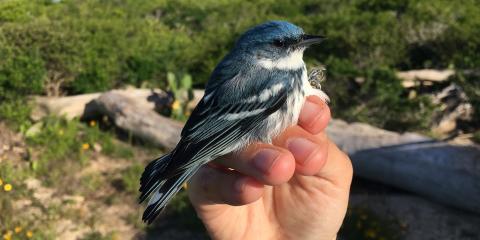
Hubbard Brook Expedition Blog ›
Surveys have been conducted at Hubbard Brook since 1999 to better understand how birds respond to a changing environment.
Treating Shanthi's Arthritis ›
Born in Sri Lanka around 1975, Asian elephant Shanthi developed arthritis in her front-left leg more than a decade ago. While there is no cure for arthritis, there are ways to alleviate the symptoms, and our animal care experts have focused on her comfort. We'll be posting the latest information on...
Stanley Crane Chick Hatched at the Smithsonian's National Zoo ›
Bird House keepers at the Smithsonian's National Zoo are celebrating the arrival of a Stanley crane chick, hatched July 10 to the Zoo's 27-year-old female and 17-year-old male. Animal care staff are monitoring the chick closely and report that it appears to be alert and strong, and the parents are...
Smithsonian Science: Elusive Elephant Reproduction ›
What affects an elephant’s ability to get pregnant? Scientists from the Smithsonian Conservation Biology Institute (SCBI) set out to solve that mystery. With help from peers across North American zoos, they evaluated elephant hormones to learn how body weight, socialization and life events affected...
Science To The Rescue In The #Fightforfrogs ›
Nearly one-third of all amphibian species globally are at risk of going extinct. While the global amphibian crisis is the result of habitat loss, climate change and pollution, the deadly amphibian chytrid fungus plays a large role in the frogs' disappearances. In the fight for frogs, Smithsonian...
Smithsonian Science Q&A: Tracking Scimitar-Horned Oryx ›
What happens when a species is restored to its rightful place in the wild? In the case of the scimitar-horned oryx, the answer to that question has been nearly 30 years in the making. Next month, 25 oryx will be released to a large reserve in Chad, a country where they have been extinct in the wild...
The Curious Colonization of the Humboldt Penguin ›
When it comes to choosing a location for a natural gas marine terminal, PERU LNG (Liquefied Natural Gas) discovered that the options are not always black and white. When their construction site became the home of choice for Humboldt penguins, PERU LNG called upon the Smithsonian Conservation Biology...
Smithsonian Science: A Weight Loss Plan That Works... For Kiwi ›
For the first time, the Smithsonian Conservation Biology Institute (SCBI)'s kiwi pair are parents! Keeper Wesley Bailey reveals how a strict diet helped dad Ngati Hine Tahi get in shape and resulted in the pair's first chick. This story appears in the July 2016 issue of Smithsonian Conservation...
Zoo to Peru: Andean Bear Adventure ›
Smithsonian's National Zoo scientists are all over the globe and, most recently, at the peaks of Machu Picchu, Peru! Andean bear curator Craig Saffoe, chief veterinarian Don Neiffer, and Smithsonian Conservation Biology Institute scientist Francisco Dallmeier trekked to South America to share...
Smithsonian Science Q&A: Macaques with Wolfgang Dittus ›
For nearly 50 years, Smithsonian Conservation Biology Institute primatologist Wolfgang Dittus has studied and lived among the toque macaques in Sri Lanka. In our Q & A, he reveals how family relationships, intelligent behavioral strategies and a healthy environment are key to this species’ survival...
Smithsonian Cheetah Science Q&A ›
As their native habitat continues to shrink, wild cheetahs are facing a drought of genetic diversity. This is in direct contrast with the population of cheetahs in zoos, which is as genetically diverse as it was 30 years ago because of cooperative and strategically managed breeding programs. The...
Science Q&A: Freezing Coral In Time ›
Smithsonian Conservation Biology Institute (SCBI) scientists are working furiously to beat the bleaching clock and cryopreserve coral. But, they’ve run into a wall: bleaching is causing coral to produce poor-quality sperm and eggs. In turn, less are able to settle or survive the cryopreservation...
Sea Lion Pup Born at the National Zoo ›
For the first time in 32 years, the Smithsonian's National Zoo's American Trail team celebrated the arrival of a sea lion pup, born June 26 to 11-year-old mother Calli. Keepers watched the birth in an off-exhibit area and continue to closely monitor the pup, which appears to be nursing, moving and...
Maned Wolves are Back on Exhibit at the Smithsonian's National Zoo ›
The Smithsonian's National Zoo recently welcomed two new residents to its Cheetah Conservation Station: maned wolves.