News Archive
Filter By
Displaying 1451 - 1475 of 2496 articles.
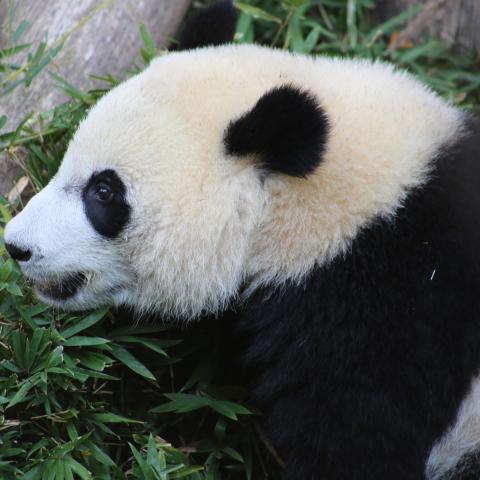
Bei Bei's Growing Up ›
Bei Bei is becoming more and more independent from his mother Mei Xiang every day. It is hard to believe, but the time is rapidly approaching when he will live separately from her. He has a voracious appetite, and relies very little on milk from Mei Xiang. He weighs 90 pounds (the largest of Mei...

First Wild Horse Born From Artificial Insemination Moving From the Smithsonian Conservation Biology Institute ›
The first Przewalski’s (cha-VAL-skee) horse born from artificial insemination moved from the Smithsonian Conservation Biology Institute (SCBI) to the Dakota Zoo in Bismarck, N.D., today, Nov. 21. The move is based on a breeding recommendation. The mare, Christine, was born July 27, 2013, and her...
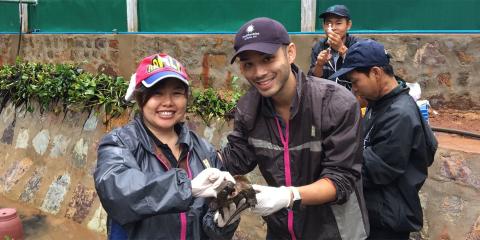
Turtle Survival Alliance: Big-Headed Turtle Confiscation in Myanmar ›
On Nov. 7 2016, approximately 800 big-headed turtles ( Platysternon megacephalum) were confiscated from Chinese traders arrested in Tachileik, Myanmar. Dr. Marc Valitutto of Smithsonian Global Health, stationed in Myanmar to conduct pangolin health research, was called upon to provide lifesaving...
Elderly Gray Seal Dies at the Smithsonian’s National Zoo ›
The Smithsonian's National Zoo’s senior female gray seal, Selkie, died today. At 43 years old, Selkie was the oldest gray seal living in human care. The lifespan of a wild gray seal is usually 25 or 30 years. Typically, female gray seals in human care can live close to 40 years; male seals live...
Vote to Name the Agouti Baby ›
The Smithsonian National Zoo's new agouti needs a name and we need your help! As mom is “Hazelnut,” dad is “Pistachio” and sibling #1 is “Coconut,” the new agouti will help complete the mixed “nut” exhibit at the Small Mammal House. Native to South America and similar in appearance to a Guinea pig...
Preparing for the Second Release of Scimitar-Horned Oryx to the Wild in Chad ›
I traveled to the United Arab Emirates in early October to work on the second release of Scimitar-horned Oryx with our collaborators from the Environment Agency—Abu Dhabi (EAD). Scimitar-horned oryx are a desert antelope native to Northern Africa. The first release was completed over the summer when...

What Sound Does a Forest Make? ›
SCBI's Center for Conservation and Sustainability is in Peru's Amarakaeri Communal Reserve recording how life is responding to an area of the forest designated for natural gas exploration. Researchers Tremaine Gregory and Jessica Deichmann give us the scoop on their findings in this Science Q&A.
Media Advisory: ZooLights, Powered by Pepco, Returns to Smithsonian’s National Zoo ›
ZooLights, powered by Pepco, at the Smithsonian’s National Zoo is wilder than ever and a perfect holiday event for families. Hosted by Friends of the National Zoo, the festival will run over 35 days and features thousands of environmentally friendly LED lights.
Male Andean Bear Cisco Dies at the Smithsonian's National Zoo ›
A 23-year-old male Andean bear named Cisco died at the Smithsonian’s National Zoo Oct. 24 during an emergency veterinary exam. In the past week, Cisco became less active and began breathing more heavily with an occasional cough. Those signs worsened over the weekend and his appetite declined, which...
Giant Panda Bao Bao Moving to China Next Year ›
Giant panda Bao Bao will depart the Smithsonian’s National Zoo for China in late winter, within the first few months of 2017.
Bao Bao's Departure FAQs ›
Read on for some of the most frequently asked questions about Bao Bao's departure.
Geriatric Sloth Bear Dies at the Smithsonian’s National Zoo ›
A 21-year-old female sloth bear named Hana was humanely euthanized at the Smithsonian’s National Zoo Monday, Oct. 17. In human care, sloth bears typically have a median life expectancy of early-to-mid 20s. Hana exhibited signs of lethargy and discomfort as well as a decline in appetite over the...
Vector Surveillance in Kenya's Camels ›
In Kenya, the Smithsonian Institution maintains a close collaboration with the Mpala Research Center and Ranch (MRC) located in Laikipia County.
Zoo Improvement Collaboration in India ›
Smithsonian's Global Health Program is a contributor to the partnership between the Smithsonian’s National Zoo and Conservation Biology Institute and India’s Central Zoo Authority. This collaboration aims to share best-practices in veterinary medicine and diagnostics with zoos in India, which are...
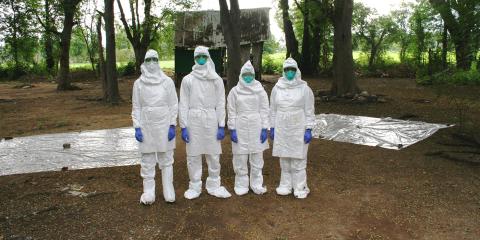
Virus Detection in Myanmar's Bats ›
Smithsonian's Global Health Program (SGHP), through the U.S. Agency for International Development (USAID) PREDICT program, aims to strengthen developing countries’ ability to detect, control and prevent infectious diseases.
The Vets Visit Bei Bei ›
Our veterinary team visited the giant panda habitat last week for routine checkups on all of the pandas. Of special note in Bei Bei's check-up, the team successfully collected blood and gave him two vaccinations. He held still for the procedure because keepers treated him to honey water. Keepers...
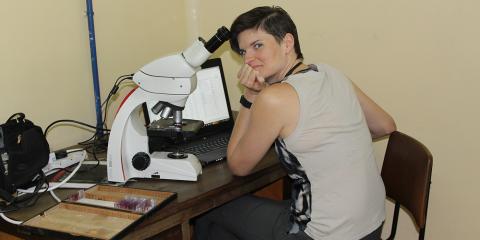
Update on Kenyan Rhinos ›
When a mysterious disease emerged in Kenyan black and white rhinos, Dr. Kali Holder headed Kenya to examine samples and train technicians in sample processing, hoping to discover clues to the cause of the disease.
A Beetle Invasion ›
If you want to understand why trees are dying, just ask Kristina Anderson-Teixeira. Anderson-Teixeira’s job is to study forests and their interactions with climate. As a research biologist at SCBI’s Conservation Ecology Center, one of her particular interests is patterns in tree mortality. The...
SCBI Scientists Crack the Crane Case ›
For many endangered species, their future is only as promising as their genes are diverse. Genetic diversity is key to a population that is self-sustaining and can more effectively fight off disease. When it comes to cranes, which mate for life and produce relatively poor semen samples, bolstering...
Good News for Great Apes ›
What’s a zoo to do when an orangutan has the sniffles? Treatment depends on whether the infection is viral or bacterial, says Priscilla Joyner, the Smithsonian Conservation Biology Institute’s (SCBI’s) veterinary medical officer. She has teamed up with colleagues at the University of Miami to...