News Archive
Filter By
Displaying 1351 - 1375 of 2496 articles.

A Day in the Life of a Primate Keeper ›
Ever wondered what it would be like to care for an endangered animal? For the team who works with the Smithsonian's National Zoo's primates-- gibbons, siamangs, lemurs, orangutans and gorillas, among others-- the job entails thinking of creative ways to provide these intelligent animals with...

Saving Gabon’s Forest Elephants ›
Every fall, forest elephants venture onto Shell Gabon’s Yenzi camp in search of mangos, putting both animals and humans in jeopardy. Smithsonian Conservation Biology Institute scientists are helping the camp’s staff manage and safely share the land on which both elephants and humans depend.

Smithsonian-led Study Lays Groundwork To Uncover Role of Migration in Bird-Population Declines ›
The period of a migratory bird’s annual cycle thought to be the most perilous—its twice-annual journeys over oceans and inhospitable landscapes—is also the least understood. A new collaborative study led by the Smithsonian Migratory Bird Center (SMBC) synthesizes what is already known and outlines...

A Surprise Egg ›
In March, female Cuban crocodile Rose underwent a series of tests to determine if she is still capable of producing healthy eggs. It all began with an egg — a perfectly smooth, white, oval-shaped, normally-sized egg — that Rose laid two months early. Nesting season for Cuban crocodiles does not...
Smithsonian Scientists Examine Impact of High-Severity Fires on Conifer Forests ›
The ability of some conifer forests to recover after severe fire may become increasingly limited as the climate continues to warm, Smithsonian Conservation Biology Institute (SCBI) scientists found in a new study published today in Global Change Biology. Although most of these cone-bearing evergreen...

Winter Ecology in Jamaica Expedition Blog ›
It has been a busy field season tracking the ecology of migratory birds down here at the long-term study site at the Font Hill Nature Preserve in southwest Jamaica. This year, we’ve been working on projects that include assessing how wintering bird populations change through time, the consequences...

Smithsonian Conservation Biology Institute Announces Names of Five Cheetah Cubs ›
Last week, the public was invited to help name five of the 10 cheetah cubs born in late March at the Smithsonian Conservation Biology Institute (SCBI) in Front Royal, Virginia. T he cheetah cubs have been named Maathai, Fossey, Murie, Leopold and Roosevelt.

Coral in Crisis ›
Smithsonian Conservation Biology Institute's Mary Hagedorn and the Reef Recovery Initiative have been making great strides in the effort to save the world’s coral reefs.

Earth Optimism: Cheetahs ›
First come cubs, then comes species recovery. Find out how a thriving population in human care benefits wild cheetahs.

Earth Optimism: Elephants ›
WATCH: The Smithsonian's National Zoo and Conservation Biology Institute's care and study of Asian elephants has a positive impact on the species.
Help the Smithsonian Conservation Biology Institute Name Its Cheetah Cubs ›
The public is invited to help name five of the 10 cheetah cubs born in late March at the Smithsonian Conservation Biology Institute (SCBI) in Front Royal, Virginia.

An Andean Bear Adventure (Part II) ›
What does it take to care for an Andean bear? In March, Smithsonian’s National Zoo and Conservation Biology Institute (SCBI) staff returned to Peru—the bears’ home turf—to share their expertise.

Earth Optimism: Helping Wild Elephants Where They Roam ›
Why is this Asian elephant wearing a collar? He’s one of four pachyderms whose movements and behaviors are being tracked via satellite! This information helps SCBI scientist John McEvoy and partners understand the causes of human-elephant conflict and find solutions to help animals and people...

Earth Optimism: A Vanishing Species Reappears ›
When researchers discovered Craugastor evanesco in the rainforests of Panama, they called it the vanishing robber frog. Now, however, the species may have a fighting chance at a future thanks to the Panama Amphibian Rescue and Conservation Project, which in December became the first program to breed...

Earth Optimism: Saving the Savannah’s Great Cats ›
Sometimes, even top predators need a leg up in order to survive. The recent boom in Kenya’s human population prompted people to sprawl and build their homes on the savannah. As a result, increased competition among wildlife for territory, food, water and mates can spell trouble for many the animals.

Colombia Expedition Blog ›
Breeding Birds Between (Coffee) Bushes La Sierra Nevada de Santa Marta of Colombia has two seasons: dry and wet. Even in the dry season, though, rainfall and cloud cover can be common, just like there are sunny days during the wet season. Some coffee farms simply cannot plant a lot of shade over...

Earth Optimism: Saving Frogs with Science ›
Smithsonian Conservation Biology Institute scientists are saving frogs with science. Release trials in the wild begin spring 2017. On Earth Day weekend, the Smithsonian is convening the Earth Optimism Summit, an event about the science that's working to solve complex conservation challenges around...
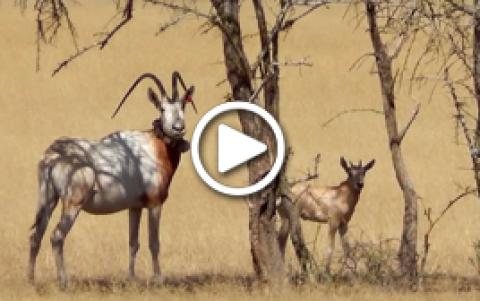
Earth Optimism: Oryx ›
Extinct in the wild for more than 35 years, scimitar-horned oryx are back in their native habitat thanks to international collaboration and the power of science.
Smithsonian Scientists Discover Two Colorful Geckos in Vanishing Myanmar Rainforest ›
Smithsonian scientists have discovered two new gecko species, the Lenya banded bent-toed gecko and Tenasserim Mountain bent-toed gecko, in the little-studied lowland forests of Myanmar.

Bornean Orangutan Infant Crosses O-Line for the First Time at the Smithsonian’s National Zoo ›
On April 4, the Smithsonian’s National Zoo’s nearly 7-month-old male Bornean orangutan, Redd, took his first trip on the O-Line carried by his mother, Batang. The 50-foot-high suspended cable track gives orangutans the choice and freedom to move between their yards at the Great Ape House and Think...
Elderly Golden-Headed Lion Tamarin Dies at the Smithsonian’s National Zoo ›
Keepers at the National Zoo’s Small Mammal House are mourning the loss of Zikki, a golden-headed lion tamarin who was humanely euthanized April 8. At 17 years old, Zikki was considered geriatric for her species.
Twelve Cheetah Cubs Born at Smithsonian Conservation Biology Institute ›
The start of spring brought a cheetah cub boom to the Smithsonian Conservation Biology Institute (SCBI) in Front Royal, Virginia, where two large litters were born over the course of a single week.

Restless Night for Bei Bei ›
Overnight, keepers observed that Bei Bei was unsettled and may have experienced some nausea. Staff came into the panda house overnight to watch him more closely. Bei Bei was thoroughly checked by a Zoo veterinarian early this morning, and he appears to be perfectly fine. He is eating well and...
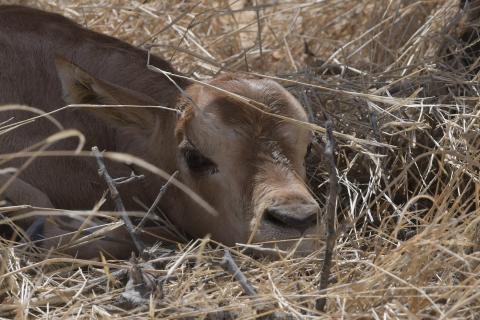
Scimitar-horned Oryx Calves Born in the Wild ›
Three scimitar-horned oryx calves have now been born in the wild. Species reintroductions led by Environment Agency – Abu Dhabi and the Government of Chad began last year. SCBI ecologists collect behavioral data on the reintroduced oryx using satellite collars.

Equus Unicornu Science First ›
Smithsonian Conservation Biology Institute scientists have captured images of the first known images of a unicorn (Equus unicornu) in the wild.