News Archive
Filter By
Displaying 1301 - 1325 of 2496 articles.

A Day in the Life of an Elephant Keeper ›
For Asian elephant keepers, working among the giants of the animal kingdom entails training, enriching and caring for the Zoo's multi-generational herd, as well as contributing to research and educating visitors about the conservation of this endangered species.

Reading the Hormones ›
Behavior can tell the giant panda team quite a bit about the pandas, but the behaviors they exhibit are only half the story. When it comes to predicting when Mei Xiang will give birth, or when she is in the final stages of a pseudopregnancy, scientists rely on a few different factors. They monitor...

Spotlight on Training: Asian elephant Kamala ›
Ever since 42-year-old Asian elephant Kamala arrived at the Smithsonian’s National Zoo in May 2014, keeper Amanda Bobyack has helped her settle into her habitat. Part of that adjustment included learning husbandry and medical training behaviors that help Bobyack, her fellow keepers and the vet team...

Council Membership Program: Supporting the National Zoo ›
You can increase your impact on the Smithsonian’s National Zoo and Conservation Biology Institute’s mission by becoming a Council member. Membership at the Council level enables our science research to reach further and helps our Zoo’s exhibits to shine even brighter.
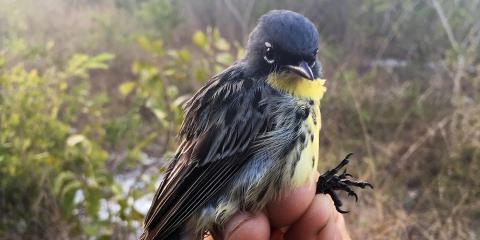
Kirtland's Warbler Expedition Blog ›
The Kirtland's warbler is an endangered migratory songbird that breeds almost exclusively in Michigan and winters primarily in the Bahamas. The species nests on the ground and will only breed in young Jack Pine forests. Decades of fire suppression prevented the formation of new breeding habitat for...

Watch: Kiwi Hatching ›
See the beginning of a kiwi egg hatching in this behind-the-scenes Facebook Live at the Smithsonian Conservation Biology Institute!

Smithsonian’s National Zoo Sumatran Tiger Cub Update ›
As the world prepares to celebrate Global Tiger Day this Saturday, July 29, Great Cats keepers have some big news to share about the 2-week-old Sumatran tiger cub in their care: it appears to be a boy!
Elderly Przewalski’s Horse Dies at the Smithsonian’s National Zoo ›
Keepers at the Smithsonian’s National Zoo are mourning the loss of Minnesota, a Przewalski’s horse who was humanely euthanized yesterday morning.
Holstein Cow Dies at the Smithsonian’s National Zoo ›
Kids’ Farm keepers at the Smithsonian’s National Zoo are mourning the loss of Tulip, a 13-year-old Holstein cow who was humanely euthanized July 24.

Keepers Hand-Raising Dama Gazelle Calf at Smithsonian Conservation Biology Institute ›
Animal keepers at the Smithsonian Conservation Biology Institute are hand-raising a dama gazelle calf. The male calf was born July 4.
Three Endangered Red Panda Cubs Born at Smithsonian Conservation Biology Institute ›
Two litters of red panda cubs were born at the Smithsonian Conservation Biology Institute last month within days of each other.

Giant Pandas in Summertime ›
Activity at the giant panda habitat has slowed since the flurry of breeding season in May. Keepers, Smithsonian Conservation Biology Institute scientists and veterinarians were monitoring Mei Xiang very closely to determine when she would ovulate. Her chance to conceive a cub arrived May 25. Now...

Brown Pelican Banding on Adam Island ›
On July 11, Smithsonian Migratory Bird Center scientist Autumn-Lynn Harrison set out to deploy GPS tags on the Chesapeake Bay’s brown pelicans to track their migrations and better understand the iconic birds.

Home, Sweet (Artificial) Home ›
About 100 kilometers south of Lima on the coast of Peru, an expansive community of marine invertebrates, fish and seabirds has taken up residency in a seemingly unlikely place: in the hard-bottom space created by a barrier, called a breakwater, protecting South America’s first Liquefied Natural Gas...
Smithsonian Scientist and Partners Revolutionize Vital Conservation Tool With Use of Gold Nanotechnology and Lasers ›
A new cryopreservation study has sweeping implications for wildlife conservation and human health. In a paper published July 13 in ACS Nano, the Smithsonian Conservation Biology Institute and University of Minnesota provide the first-ever reproducible evidence for the successful cryopreservation of...

Tortoise Dudes and Duds: A Q&A with SCBI’s Rob Fleischer ›
In a shell of a paternity test story, Smithsonian Conservation Biology Institute (SCBI) scientists found that male desert tortoises that had been relocated from a threatened habitat to a new nearby home are reproducing at a much, much lower rate than resident males. Genetic paternity testing of 92...

Island Scrub-jays Defy Biological Expectations…Again ›
The island scrub-jay, a songbird endemic to Santa Cruz Island off the coast of southern California, has made headlines in recent years for bucking evolutionary and biological trends—and is at it again this year.

Newly Collared Giraffes in Kenya Could Pave Path for Species Conservation ›
In June, SCBI scientists and partners fitted the ossicones of 11 reticulated giraffes with GPS collars that send hourly data to researchers via satellite.
Sumatran Tiger Cub Born at the Smithsonian’s National Zoo ›
Great Cats keepers at the Smithsonian’s National Zoo are celebrating the birth of a Sumatran tiger, a critically endangered species. The cub’s mother, 8-year-old Damai, gave birth at 4:17 p.m. on July 11.
Red Panda and Dama Gazelle Die at the Smithsonian Conservation Biology Institute ›
An adult female red panda and an adult female dama gazelle died at the Smithsonian Conservation Biology Institute during the past week. Both deaths were the result of natural causes.

Working Landscapes and Seascapes Secretary’s Scholar ›
In January, Tom Akre, former director of Virginia Working Landscapes (VWL), was appointed to the new position of Working Landscapes and Seascapes Scholar.

Circle of Life Society Annual Donor Recognition Event ›
On June 8, the Smithsonian’s National Zoo and Conservation Biology Institute hosted 27 Circle of Life Society donors for an exclusive donor recognition event at the Zoo’s Research Hill—home to the Center for Conservation Genomics, Smithsonian Migratory Bird Center and Department of Wildlife Health...

Orangutan Infant Redd Explores His Surroundings ›
Bornean orangutan infant Redd is 9 months old! Although he still sticks close to mom, Batang, and she keeps a watchful eye on him, he is very active and seems to enjoy exploring his surroundings.

The Secret to Saving a Species ›
Shell-ebration is in order for the Reptile Discovery Center, where two critically endangered Bourret’s box turtles hatched for the first time in the Smithsonian’s National Zoo’s history. This conservation success was more than a decade in the making for animal keeper Lauren Augustine, who manages...

Predicting the Future of Global Health: Kenya ›
How does a conservation organization stop a threat to wildlife that cannot be seen by the naked eye? They examine it under a microscope.