News Archive
Filter By
Displaying 2426 - 2450 of 2496 articles.

Smithsonian's National Zoo Seeking Bamboo to Bolster Dwindling Supply ›
The Smithsonian’s National Zoo is experiencing a critical and unexpected shortage of its bamboo supply and is reaching out to local landowners and farmers who have bamboo and will allow the Zoo to harvest and manage their crop.
Zoo Has a New Baby Gorilla ›
Yesterday, a baby western lowland gorilla was born at the Smithsonian’s National Zoo. Staff estimate the baby was born at approximately 1:45 p.m. to 26-year-old female Mandara and 16-year-old Baraka. The newborn represents the seventh successful gorilla birth for the Zoo since 1991. This is the...
National Zoo and Fujifilm Invite Photographers to Take Their Best Shot! ›
If you have ever tried to capture a picture-perfect image of the National Zoo’s giant pandas or wondered how the Zoo’s photographers snap beguiling photos of animals as diverse as elephants and naked mole-rats, now is your chance to learn the tricks of the trade in a photo-challenge discussion...
National Zoo Appoints Joseph M. Sacco Associate Director for Education ›
The Smithsonian’s National Zoo has appointed Joseph M. Sacco associate director for education, effective Jan. 5, 2009. In his new role, Sacco will oversee all public education programs at the Zoo, including public demonstrations, curriculum enrichment for K-12 students, teacher workshops, community...
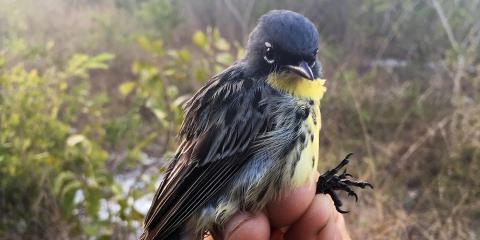
Jacked about Pines ›
Kirtland's warblers are so abundant in some parts of this ecosystem that it is hard to believe that the Kirtland's is the rarest songbird in North America, nesting almost exclusively in about 16 counties in northern Lower Michigan.

And Less Well-known Sap Feeders ›
If you read Mary Deinlein's profile of the yellow-bellied sapsucker that appeared in this series in 2003, you know that we have learned a lot about the sap feeding habits of this highly specialized woodpecker. But as they say “Here is the rest of the story!” “A singular habit…and one with which all...

Kissing Cousins ›
Hanging upside down on branches, stealing insects from the undersides of leaves, this acrobatic and gregarious bird is always a welcome sight. Though a common visitor to backyard feeders throughout the southeastern United States, we still have much to learn from this charismatic songbird. Throughout...
An Island of Their Own ›
As soon as they step off the boat onto Santa Cruz Island, the largest of the eight California Channel Islands, a distinctive, metallic call greets visitors. This call belongs the island scrub-jay, a large, strikingly blue bird with a whitish-gray breast and a prominent black bill.
Noble in Its Proper Place ›
The rock pigeon is the official English name for our common city pigeon. It is as noble as any animal when you view it in its proper place.
Daring to be Different ›
The game of survival is all about carving out your niche and being successful in it. Within the natural world, few birds play this game better than the American dipper (Cinclus mexicanus).
A Closer Look at an Ordinary Species ›
To many bird enthusiasts, the white-throated sparrow is just an "average Joe." In fact, I suspect that few birders living in Canada and the eastern United States have celebrated the long-awaited addition of the white-throated sparrow to their life lists.
Consummate Opportunist ›
Few birds are so easily identified in flight as a crow, cutting a sharp, sleek image against the sky or a woodland edge with powerful, deliberate wing beats and black form.
Bird of Coffee and Chocolate ›
The Baltimore oriole is perhaps the most famous neotropical migratory bird. Its brilliant orange and black plumage is reminiscent of the crest of Lord Baltimore, an important figure in Maryland's history, and the bird has become the mascot of the Baltimore Orioles baseball team.
Toughest of Birds, Dressed Up as a Clown ›
The harlequin duck (Histrionicus histrionicus) is a cult bird. I came to this conclusion very early in life. I grew up birding in Northern California in the '60s and '70s when breeding harlequins had been gone so long there they didn't even qualify as an ornithological memory.
Swamp Thing ›
The northern waterthrush ( Parkesia noveboracensis) is a swamp thing, a seeker of wet woodlands far from where most people go. Summers are spent amid the swamps and sluggish rivers of the far north's forests, with beavers, moose, and bears for neighbors. In winter, they head south to tropical swamps...

The Suburban Bird ›
The widespread American robin is one of our most familiar birds and its arrival in spring is eagerly anticipated.

The Coffee Warbler ›
Despite its misleading name, the Tennessee warbler neither breeds nor over-winters in the state of Tennessee. This species got its name when the first specimen collected had the misfortune of being shot by Alexander Wilson in 1832. This unlucky individual happened to be passing through Tennessee...
Big Mouth, Small White Bib ›
As darkness descends along rural roadsides from Texas to Argentina, mysterious ember-like dots appear near ground level. Reflecting the beams of car headlights, this orange glow emanates from the eyes of a cryptic bird of the night known as the Common Pauraque. With the onset of twilight, pauraques...
Herds of Hungry Deer Spell Change for U.S. Forests ›
By John Barrat, Smithsonian Office of Public Affairs Something is squirming inside a white athletic sock marked with the number 16 and hanging from the belt of biology student Jessica Hollis. Standing in the deep woods of the Smithsonian National Zoological Park's 3,200-acre Conservation and...

A Blue Birding Prize ›
For many North American birdwatchers, the Cerulean Warbler is one of the most sought-after species during spring and summer. This elusive, azure-colored songbird is uncommon over most of its breeding range, and spends the majority of its time high in the forest canopy, giving it a reputation for...
The Early Bird ›
Eastern Phoebes are one of the first migratory birds to arrive in the spring in the northeastern United States. They often appear in March, well ahead of the peak migration for most forest songbirds (in May), and they are one of the last to leave in fall, with the peak of migration in October. Their...
Twilight Serenade ›
The sun is just about to rise on a cool December morning on the Eastern Shore of Maryland. The birds awaken at the forest edge and begin calling vociferously: the harsh "shack" call of the Northern Mockingbird, a variety of "chip" calls from cardinals, sparrows, and yellow-rumped warblers, and the...

Happy Blue Warbler ›
In summer in the Appalachian Mountains, its buzzy zoo zoo zoo zee song can often be heard drifting from dense stands of rhododendron and mountain laurel. As the naturalist Lynds Jones wrote in 1899, “The song is uttered in a spirited manner while the bird is feeding and flitting about in the foliage...
The Master Sap Tapper ›
Although its name sounds like an insult Yosemite Sam might sling at Bugs Bunny, the yellow-bellied sapsucker's moniker aptly describes its appearance and habits. Both males and females indeed have a pale yellow underside, and tree sap constitutes a large portion of this woodpecker's diet. In fact...

Warbler in Disguise ›
On a cool spring morning in downtown Baltimore this year, the breeze was blowing and the hustle and bustle of an urban city were evident.