News Archive
Filter By
Displaying 2451 - 2475 of 2496 articles.

Winged Pirate of the High Seas ›
An Arctic Tern hovers high above the water, zeroing in on the fish it intends to take back to the nest to feed its ravenous young. With perfect precision, it dives head first into the water and is back in the air within seconds, the fish dangling from its bill. Urged on by parental instinct, the...

Island Misfits ›
Most birders in North America are no doubt familiar with the orange-crowned warbler ( Oreothlypis celata). The species breeds throughout the western U.S. and across the boreal forest from Alaska to Newfoundland, winters in much of Mexico and the southern U.S., and migrates through a broad swath of...
Sitting in the Catbird Seat ›
Singing from a concealed perch, the catbird truly enjoys its comfortable position. With its tail held down, body feathers fluffed, and wings drooping at its sides, the catbird exuberantly sings a series of musical whistles and catlike meows, interspersed with imitations of other birds' songs. Video...
The Troubled Blackbird of the Bog ›
Once upon a time, you could, on a summer's day, count on hearing the creaky song of the Rusty Blackbird ( Euphagus carolensis) filtering from the bog lands of the boreal forest. Decades ago, on a winter's day, one could reliably locate small flocks of Rusties foraging at the edge of the swamps in...
Bird of Many Voices ›
Wait. I think I hear a Summer Tanager calling from that shrub over there. No, it sounds more like a Great Crested Flycatcher. But, in a shrub?? No I think I'm hearing a Rufous-sided Towhee!? Is this a strange flock? Hold it, I see a bird that's small and olive, with some yellow below…It's a White...
A Migratory Bird with Sexual Equality? ›
This species is well named for its blue-gray head that contrasts with white 'spectacles' yellow sides, white wing bars, a greenish back and white belly and throat. However appropriate the name, birders may find the process of naming this vireo confusing. It is clearly the victim of changing...
Royalty of the Boreal Marshes ›
When birdwatchers list their most beautiful birds, the Swamp Sparrow is seldom, if ever, mentioned. In the world of ornithological aesthetics, sparrows get short shrift. They do not possess the vibrant and gaudy colors of a warbler, tanager, or toucan. However, some bird aficionados tire of spectral...
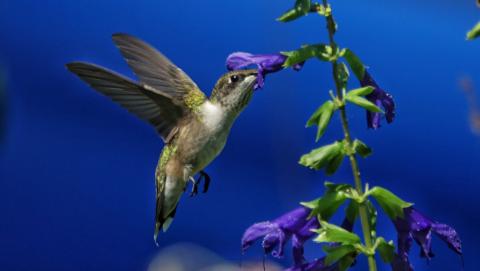
The Hummingbird Diet: How To Gain Weight And Keep It ›
Like a sumo wrestler, the rufous hummingbird must rapidly gain weight and keep it on, despite extraordinary physical exertion. Weighing in at a little more than a penny, it must double its body weight in order to fuel its migration from breeding grounds in the Pacific Northwest (Alaska to northern...
¿Por qué a las aves migratorias les fascina el café? ›
En medio de un ambiente cada vez más alterado y reducido, tanto en Norteamé-rica como en la América Latina, las aves migratorias han hallado un santuario en un entorno semejante al de los bosques en las plantaciones de café tradicionales.
Las aves mantienen nuestro mundo a salvo de las plagas... ›
Varias especies de insectos, entre ellas ...experimentan ciclos vitales durante los cuales las poblaciones de cada especie se mantienen reducidas por varios años y luego son seguidas de explosiones o erupciones poblacionales.
Si se tienen alas, a volar se dijo: las adaptaciones de las aves... ›
Volar proporciona la mayor movilidad y ha hecho posible la evolución de la migración aérea como un medio para aprovechar los recursos alimenticios distantes y evitar la tensión fisiológica asociada al clima frío.
Se alerta a las aves migratorias: disminuyen los lugares... ›
Imagine que usted ha estado viajando en su automóvil durante horas.
Las aves migratorias de la región andina ›
Con frecuencia, cuando pensamos en las aves que emigran a los trópicos las ubicamos en áreas cercanas como el Caribe y México.
Cuando se trata de pesticidas, las aves son presa fácil ›
La palabra pesticida es un término que abarca todos los químicos que matan o controlan aquello que los humanos han clasificado como plaga o peste.
Conceptos básicos sobre las aves migratorias Neotropicales ›
Un ave migratoria Neotropical es un ave que se reproduce en los Estados Unidos y el Canadá durante el verano, generalmente entre mayo y septiembre, y que pasa el resto del año en México, Centroamérica, Suramérica o las islas del Caribe.
Neotropical Migratory Bird Basics ›
A Neotropical migratory bird is a bird that breeds in Canada and the United States during our summer and spends our winter in Mexico, Central America, South America or the Caribbean islands.
The Christmas Bird ›
The Turkey Vultures could be seen circling overhead from miles away and the smell was so strong it made your eyes tear. Pulling into the dump in Negril, Jamaica wasn't my idea of a fun way to spend a morning doing bird research in the West Indies, but it turned out to be a easy way to observe...
Acrobat of the Aerial Leaf Litter ›
I commonly experience the Worm-eating Warbler in two ways. During the winter, walking through the tropical forest in Belize, I hear a soft rustling through the drone of cicadas. Whipping around to place my binoculars to my eyes, I glimpse a warbler hanging head down from a leaf draped from a small...
Buoyant in Flight ›
Not many raptors can match the buoyancy, ease and grace with which Mississippi kites conquer the sky. During their brief courtship period, the kites' aerial displays to their prospective mates are a sight to behold. Throughout the year, they occupy much of their time in flight during which they...
The Bird that Loves the Bees ›
One might know the Summer Tanager by its alias, the "beebird." Due to its diet of bees, it is a well-known pest around apiaries and is persecuted by beekeepers. Primarily insectivorous, this tanager is considered a bee and wasp specialist, although it eats a wide variety of flying and non-flying...
One Small Tern Deserves Another ›
This tiny tern once was considered the perfect size to adorn ladies' hats during the late 1800s. Least terns were collected by the thousands from the Atlantic coast for this decorative purpose, only to frighteningly diminish their numbers. Although the hunting of least terns has been outlawed, today...
Better Late than Never… ›
Practically all of the birds have arrived from their migration and spring is in full swing when the eastern wood-pewee decides to grace us with its presence.
Fiery Gem ›
Those of you who have suffered from "warbler neck" may well have acquired this common birding malaise while attempting to find our Bird of the Month, high in the top of a spruce or hemlock tree. But as patient birders know, that pain in the neck can certainly yield rich rewards with even a glimpse...
Alwright, I Finally Got a Name ›
Out on the range, in the sage and pine lives the Great Basin's indomitable, spirited Empidonax, the Gray Flycatcher. The subject of much confusion in the late 19th and early 20th Centuries, this enigmatic, little gray bird was hopelessly misunderstood by ornithologists. It looks very similar to the...
Wind-surfers of the Sky ›
Standing on a hilltop in central Panama in October, you might suddenly notice that the midday sky has gone dark. Sure, clouds have rolled in as usual during the rainy season, but this dark cloud takes on a different shape—the shape of thousands of birds! Hawks, on their annual migration are flying...