
Meet Our Tiny Terrapin Hatchling

One warm August morning, Reptile Discovery Center keepers’ day began with a “turtly” awesome surprise—a painted river terrapin hatchling was spotted swimming in its parents’ pool! Its appearance marks the first time this critically endangered species has successfully bred at the Zoo. Hear how this historic hatching happened from assistant curator Matt Evans.
What is your favorite fact about painted terrapins?
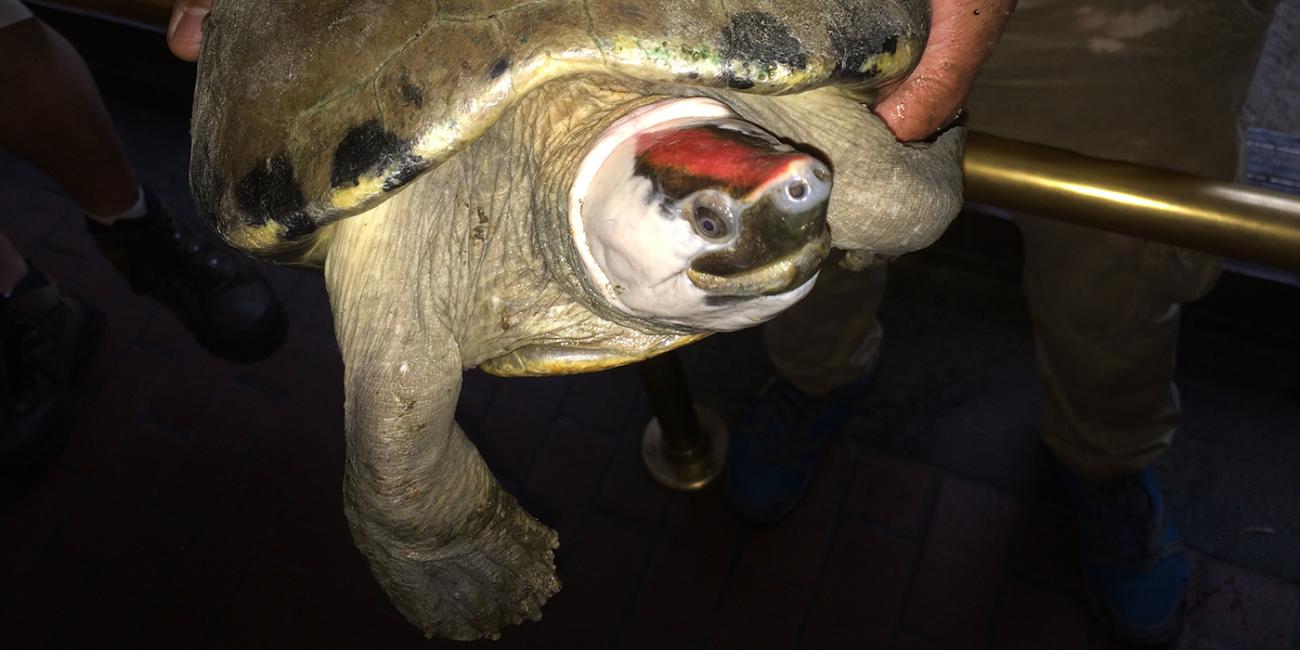
During breeding season, male painted river terrapins change colors. Their heads go from an olive-gray to bright white, with a vibrant red stripe—resembling the stroke of a paint brush—atop their head. Their shells change, too, and become streaked with prominent green, white and black stripes. They look a bit like a watermelon!
Females are much larger than the males and duller in color—their skin is gray and their shells are olive with black stripes. They also have prominent upturned snouts that give them a very distinguished look.
When did the parents arrive at the Zoo?
We received a recommendation to breed this species from the Association of Zoos and Aquariums’ Species Survival Plan. We have two adult females and two adult males at the Reptile Discovery Center. The females came from Fort Worth Zoo in 2015, and the males came from the Henry Doorly Zoo in 2017. The females are related to each other, and the males are also related to each other. As far as pairing goes, the recommendation was for either male to breed with either female.

Painted river terrapins rest in the sand. Females are much larger than males.
Who are the hatchling’s parents?
It’s a mystery! Normally, males would try to breed with the largest female. However, our females are about equal in size. Both males pursued both females, so the parents could be any combination of moms and dads.
Once a female lays eggs, her parenting role is done. Neither parent monitors the nest nor provides parental care for their young. From the get-go, hatchlings are on their own.
How do male terrapins court their mates?
Come late fall and early winter, males develop those bright breeding colors I mentioned earlier. That’s when breeding season begins, and it lasts through early spring.
When courting, a male will “dance” around the female, rubbing his head along her face, front legs and tail. And they’ll affectionately nip at their front legs. There’s a lot of pressure on the male to make all the right moves. The female is so much larger than him that, if she’s not into participating, there’s no chance at breeding. Terrapins breed a couple feet below the water’s surface. Because of this, it can be challenging for us to know exactly when breeding occurs, unless we happen to be in the right place at the right time. Outside of breeding season, we’ve observed males trying to pursue females—but the females just climb out of the water to get away from them.

Many turtle eggs are round like a ping pong ball, but painted river terrapins' eggs are oblong.
Where do females lay their eggs?
In order for females to nest, conditions have to be just right. In the wild, this species lives in river estuaries and mangrove swamps with deep sand embankments. Females can be picky about where they lay their eggs. We provided them with a sandy beach, but because their exhibit is so large, we weren’t sure if it would be warm enough to incubate eggs.
Luckily, the female picked a great spot towards the back of the exhibit, where there is a heated basking area for the tomistoma—a crocodilian species that shares the terrapins’ habitat. The tomistoma enjoys spending time there, but terrapin females are so big and sassy that she had no trouble taking over that prime basking spot!
Female painted river terrapins create nests by using their back legs to dig down deep into the sand. Then, they deposit their eggs and cover them with sand, hiding the nest. Just like sea turtles, they typically do this under cover of night. We found about 20 eggs in her nest, and a clutch between 20 and 30 eggs is common for a painted terrapin.
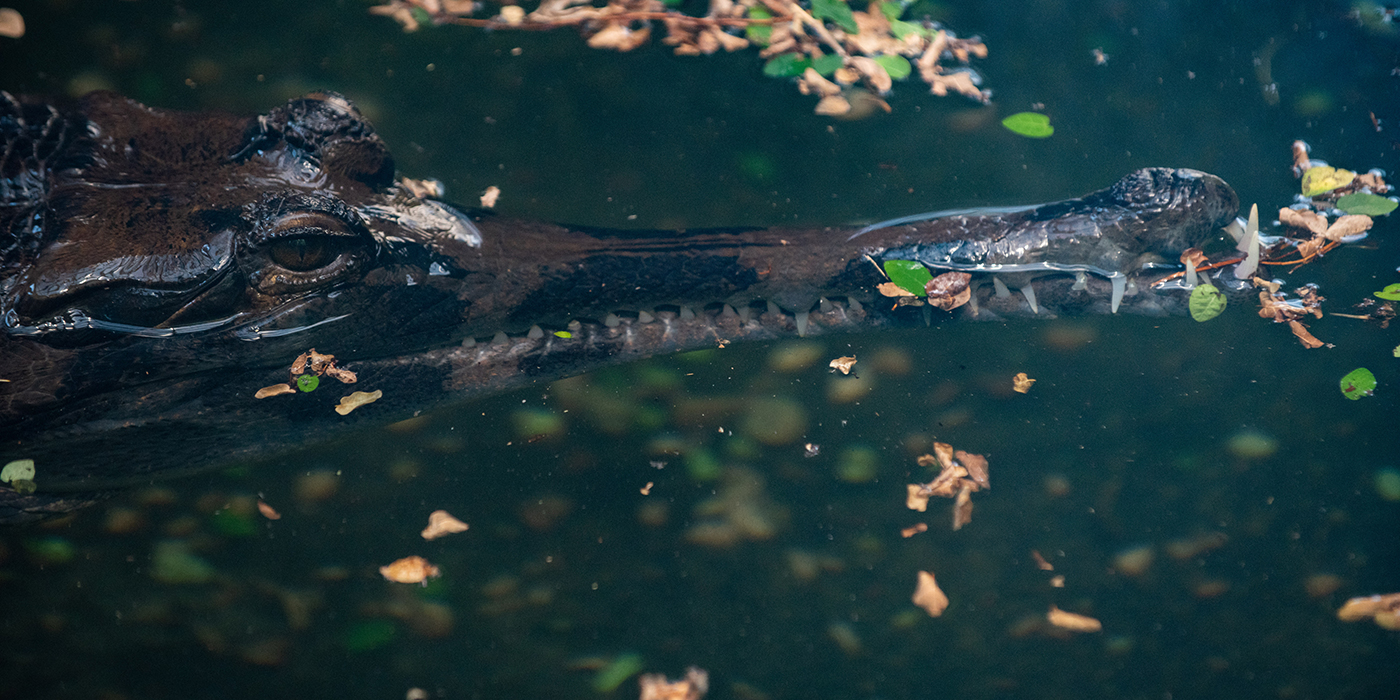
The painted river terrapin adults share a habitat with the Zoo's female tomistoma, a crocodilian species.
What do their eggs look and feel like?
A lot of turtle eggs are about the size and shape of a ping pong ball. But painted river terrapin eggs are a little more oblong and resemble a small crocodile egg! Like croc eggs, they also have hard shells—they’re not quite as thick, though.

Assistant curator Matt Evans holds the newly hatched painted river terrapin in his hands.
When did you discover the hatchling?
We found the hatchling swimming in the pool Aug. 26! I was amazed that this hatchling was able to sense where the water is. I imagine it was quite a trek to the pool, as it had to go around a giant log, up and down sand dunes, and climb over the lip of the pool—no easy feat for such a tiny turtle.
When we examined the hatchling, it seemed very strong, healthy and alert. It still had its egg tooth, which means it was only a day or two old. It’s still doing well, and we’re really happy with how it’s growing.
Is the hatchling currently on exhibit?
The hatchling is currently being cared for by keepers behind-the-scenes. We want it to grow a bit more before we introduce it back to the big pool. For the adult turtles, the 3-foot-deep pool is no big deal—but that’s pretty deep for a tiny turtle!
Painted terrapin hatchlings typically remain in the shallows to feed. We created a habitat for the hatchling that is part land, part water. It’s shallow—only about 4 inches deep—and has UV lights for basking. Just like the adults, it emerges from the water in the evenings and basks on pieces of cork bark and rocks.

Assistant curator Matt Evans takes a close look at the painted river terrapin hatchling.
When will the hatchling go on exhibit?
By the hatchling’s first birthday, it should be big enough to share an exhibit with four large adult painted river terrapins and our 12-foot-long tomistoma.
We want to make sure it will be able to compete for food with the adult terrapins, who have voracious appetites and eat quickly! The adults receive lots of leafy greens, such as romaine lettuce and dandelion greens. They also receive specially formulated pellets, veggies (carrots, sweet potatoes and squash) and fruits (apples and grapes).
Our tomistoma also has a varied diet. Her elongated snout and sharp teeth are great tools for catching fast-moving fish. This species is known to eat some mammals and smaller turtles. At 10-15 grams, a terrapin hatchling would be “snack” size for a tomistoma. The adults are not on the tomistoma’s menu, though. They can weigh between 26 and 33 pounds and are way too big for her to eat.
Do you know the sex of the hatchling?
The color of the hatchling’s shell looks more like a male, but the shape of the shell is similar to a female’s. As it matures, we will be able to definitively know its sex. Stay tuned for future updates!

A teeny, tiny terrapin! Hatchlings weigh about 10-15 grams, but they'll grow to be between 26 and 33 pounds as adults.
What do you enjoy most about working with this species?
Many turtles that are native to Southeast Asia—including this species—are in massive decline. Painted river terrapins are near and dear to my heart because they are incredibly rare. Getting a chance to work with them is really special, so I try not to take for granted how cool it is to work with them every day. And I think visitors enjoy seeing an animal from the other side of the world that they might not otherwise ever get to see.
The fact that our animals are breeding and producing healthy offspring is a good barometer that we’re meeting all their needs and doing things right. The fact that our adults have produced this beautiful hatchling—and that we could have more in the future—is especially exciting and rewarding.
I want to help painted river terrapins! What can I do?
Painted river terrapins are native to Southeast Asia in the countries of Indonesia, Malaysia, Thailand, Sumatra and Borneo. Because they live in river estuaries and mangrove swamps, they frequently come into contact with fisherman and get caught in nets. They are impacted by the illegal trade market and are often sold as pets or used in traditional medicines. And, their nesting grounds are in danger. Companies mine the sand and sell it commercially, reducing the availability of suitable nesting spots.
Every single species of plant and animal on this amazing planet exists for a reason and should have the opportunity to live and thrive. Thankfully, our partners at the Turtle Survival Alliance are working in those range countries and have dedicated staff that are protecting the habitat, breeding these turtles and releasing them into the wild. However, it will take everyone’s involvement in one way or another to keep species like the painted river terrapins from becoming extinct. You can help these tortoises, too, by refraining from purchasing animals or animal products that were taken illegally.
Of course, our Zoo is one of the best places around to see turtles from all over the world. And, every dollar you spend here contributes to our animal care and conservation programs. We hope you’ll stop by and say hello to our animal ambassadors—especially our painted river terrapins!
Can’t get enough of cold-blooded creatures? Plan a visit to the Reptile Discovery Center to feast your eyes on terrapins, tortoises and turtles of all sizes! Check out what’s on view.