
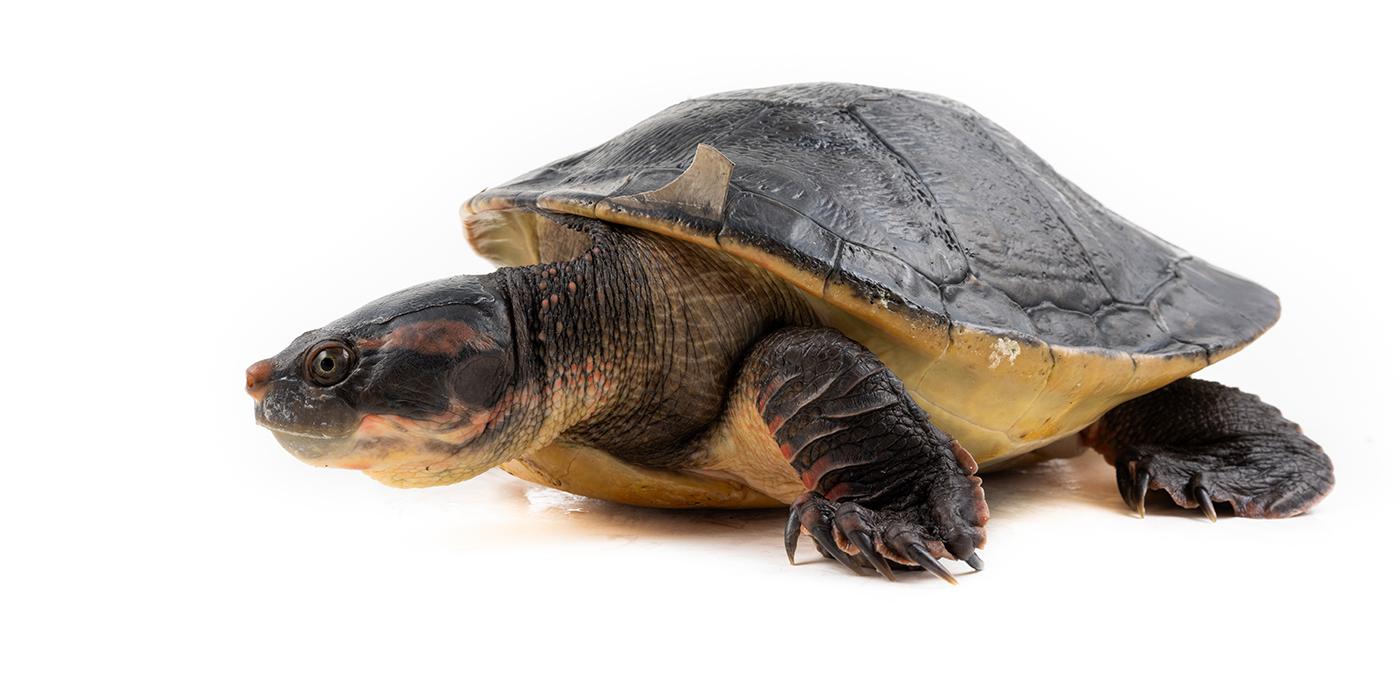
Also known as northern red-faced turtle, these animals can be found in shallow rivers and streams in northern Australia. As the name suggests, they are notable for their unusually large heads.
Physical Description
The Australian big-headed turtle has an oval shell, or carapace, that is uniformly light to dark brown, and there may be some dark patches. The head is broad with a slightly projecting snout and an unnotched upper jaw.
The surface of the head is covered with smooth skin. Head, neck and limbs are gray to olive or brown. Juveniles have two red stripes on each side of the head. One extends from the orbit to the neck and the other from the corner of the mouth to the neck. These stripes become pale pink and less prominent in adults.
Size
Their shells can measure up to 10 inches (25 centimeters) in length.
Native Habitat
The Australian big-headed turtle is native to the northwestern part of Australia. They are found in the Kimberley region between the Fitzroy River and the Princess Regent River.
Lifespan
These animals can live for more than 30 years.
Food/Eating Habits
The well-developed hard palate on the roofs of their mouths is an adaptation for crushing mollusk shells, such as freshwater snails and bivalves, which are an important part of the turtle’s diet. They also feed on insects, amphibians and some fruits.
At the Zoo, they are fed worms, shrimp, fish and turtle pellets.
Reproduction and Development
Not much is known about reproduction in Australian big-headed turtles. They generally nest from late August to early November.
Help this Species
Practice ecotourism by being an advocate for the environment when you’re on vacation. During your travels, support, visit or volunteer with organizations that protect wildlife. Shop smart too! Avoid buying products made from animals, which could support poaching and the illegal wildlife trade.
Choose your pets wisely, and do your research before bringing an animal home. Exotic animals don’t always make great pets. Many require special care and live for a long time. Tropical reptiles and small mammals are often traded internationally and may be victims of the illegal pet trade. Never release animals that have been kept as pets into the wild.
Consider going meat-free one day each week to help reduce the demand on the livestock industry and decrease your carbon footprint!
Organize or attend a stream, river, lake or other waterway cleanup in your area to preserve aquatic habitats for local species.
Support organizations like the Smithsonian’s National Zoo and Conservation Biology Institute that research better ways to protect and care for this animal and other endangered species. Consider donating your time, money or goods.
Smithsonian's National Zoo and Conservation Biology Institute. (n.d.). Australian big-headed turtle. Retrieved September 22, 2026, from https://nationalzoo.si.edu/animals/australian-big-headed-turtle
Animal News

Happy 5th Birthday, Qing Bao ›
To celebrate giant panda Qing Bao's birthday, keepers went "far out" and created a 1970s-themed fête full of bright colors and iconic pop culture slogans.

See These 5 New Animals at Your Next Visit to the Smithsonian's National Zoo ›
From a spunky new sloth to a dazzling electric eel, get ready to meet the newest residents making themselves at home.

Happy 50th 'Zooniversary' to Chyna and Rulon, the Zoo’s Aldabra Giant Tortoises ›
There are plenty of objects and artifacts at the Smithsonian that are old. But at the National Zoo, there's not much older than Rulon and Chyna.