
Managing an Animal Population? Start With Their Genes
Just like museums rely on curators to manage their collections, zoos depend on a team of skilled professionals to carefully monitor every animal in their care — recording births, breeding, behavioral and medical histories and moves between institutions. But unlike museum collections, a zoo’s “living collection” is constantly changing. Animals are born, form families and, eventually, pass away.
So, what happens to all that data? And how do zoo professionals use it to ensure the long-term health and genetic diversity of the animals they care for? Read on and get ready to have your mind blown.
Mapping the Family Tree

Spike and Trong Nhi, two of the Zoos' Asian elephants, received a breeding recommendation, based, in part, on their genetics.
One of the best defenses an animal population has against environmental change is genetic diversity. If a population is more genetically diverse, featuring a wider array of genetic variants, it can more readily adapt to shifts in the environment, such as changing temperatures and the introduction of new diseases. When zoos breed animals, they aim to retain as much gene diversity as possible, to maintain the population’s ability to adapt to changes in the environment. Populations managed in this way can serve as insurance against extinction in the wild and as a source in the event a species might need to be reintroduced.
To maintain a genetically diverse population, it helps to track how related each animal is to every other animal. To start, scientists and animal care professionals record the population’s family tree in a “studbook,” showing the identity of each animal, and the identity of its father and mother. Using these family relationships, scientists calculate each animal’s “mean kinship” — how related that animal is, on average, to the whole living population.
Population mean kinship, or the average of each animal’s mean kinship across the whole population, provides a way to estimate gene diversity. When a population’s mean kinship is low, gene diversity is high, and vice versa (if you'd like to nerd out with us, the formula is: mean kinship + gene diversity = 1). As a result, animals with low mean kinships are often good candidates for breeding, because it means they have fewer relatives in the rest of the population.
Walking a Fine Line

Evolutionarily, cheetahs are believed to have hit one or more genetic bottlenecks, resulting in generations of inbreeding.
In the wild, environmental events and human activity can drastically reduce a species’ population in a short time, which is called a “population bottleneck.” Bottlenecks are a problem for at least two reasons. First, when populations are small, they are highly susceptible to inbreeding, which is when two closely related animals produce offspring. Second, small populations lose gene diversity faster. Even if a species’ population numbers increase later, they can’t recover gene diversity lost in a bottleneck.
For many species, inbreeding over multiple generations can produce negative impacts. Because closely related animals share genetic heritage, they are more likely to carry the same maladaptive mutations—such as mutations that make an animal more susceptible to disease or infertility. When inbred animals receive two copies of the same maladaptive mutations — one from each parent— they will be less resilient. At a population level, loss of gene diversity and less resiliency can mean the population is less capable of adapting to environmental change in the long term.
Inbreeding, however, is not the only concern. When animals breed with another species or subspecies, they can produce hybrid offspring. For example, a mule is a hybrid between a horse and a donkey. Yet while hybridization can lead to health issues in some cases, scientists have found that in many populations, the practice can be less risky than inbreeding. Overall, for animals in human care, population managers make careful decisions to limit inbreeding and hybridization.
Conservation is a Team Sport
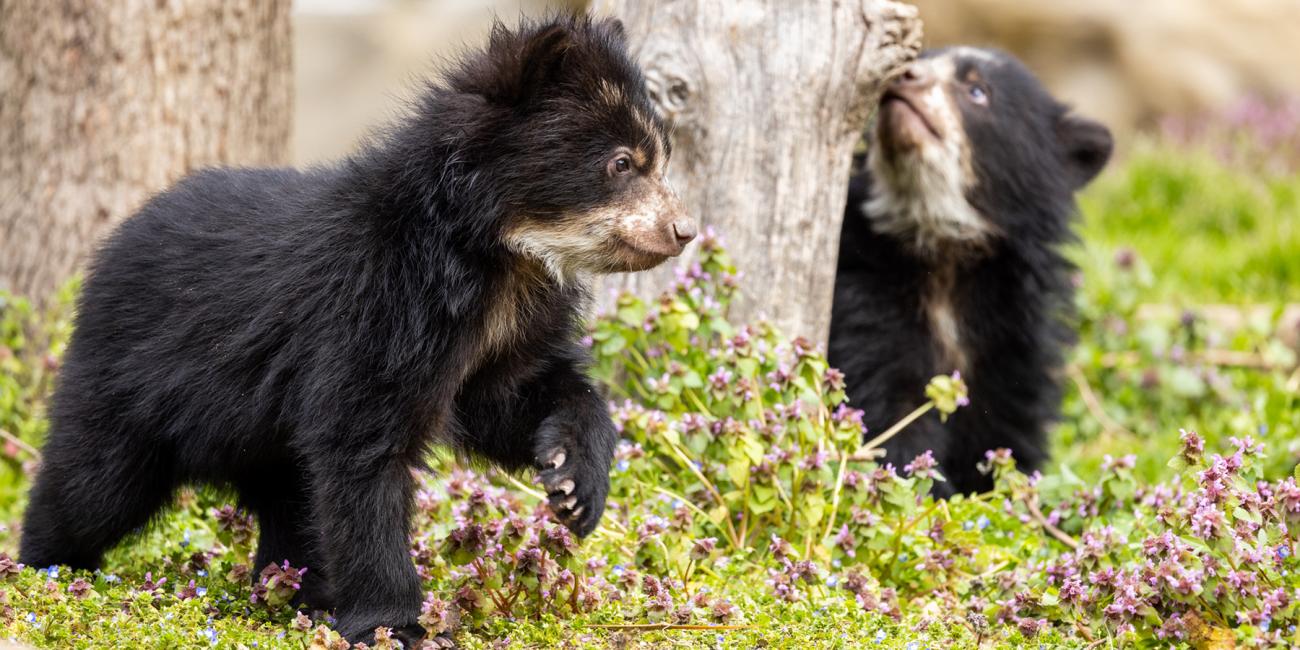
Andean bear brothers Sean and Ian were born at the Zoo in 2022. Their sire, Quito, was chosen, in part, for his unique genetics which were not previously represented in the North American Andean bear population.
Many animals at the National Zoo are part of an Association of Zoos and Aquariums (AZA) Species Survival Plan (SSP), which keeps a studbook for all the animals of that species held in AZA facilities nationwide. Sometimes, an animal’s best match is housed in a different zoo, and in these cases, AZA-accredited zoos may move an animal to another zoo to pair it with its prospective mate.
Zoos use mean kinship calculations, along with many other factors, to make decisions on animal breeding from a pool of potential mates. Scientists analyze studbook data and estimate kinship, inbreeding and other characteristics to identify optimal breeding pairs. Zoos usually focus on breeding individuals from under-represented lineages, although in limited cases, they may breed relatives to perpetuate rare lineages.
Genetics aren’t the only factor in making a breeding recommendation. Other aspects, such as an animal’s age, location, prior experience breeding, personality and behaviors can play a role, too. Zoos take all of these factors into consideration before they make a match.