
Happy 50th 'Zooniversary' to Chyna and Rulon, the Zoo’s Aldabra Giant Tortoises

There are plenty of objects and artifacts at the Smithsonian that are old. But at the National Zoo, there's not much older than Rulon and Chyna.
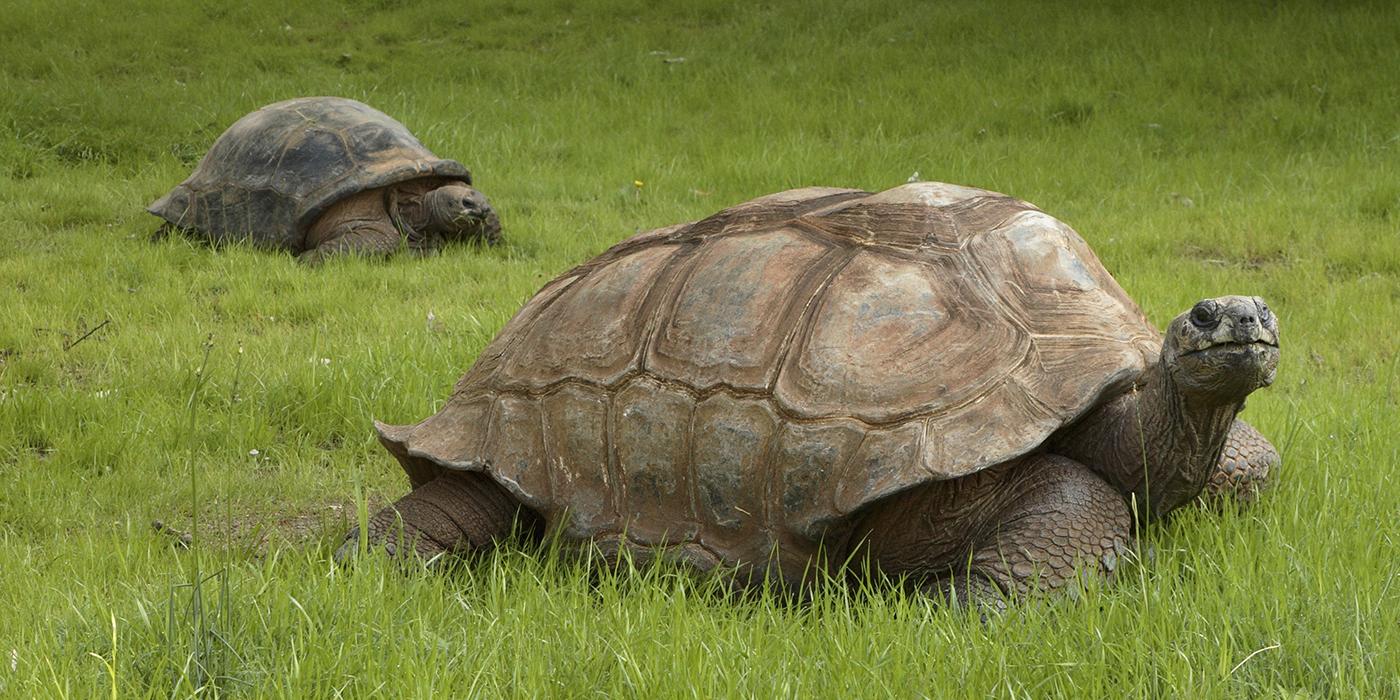
The male and female pair of Aldabra giant tortoises, who live at the Zoo’s Reptile Discovery Center, are marking their 50th anniversary at the Zoo this year.
To celebrate, the Zoo’s Commissary team is building the tortoises a special “cake” made entirely from fresh fruits, vegetables, and leafy greens. Visitors can stop by the Reptile Discovery Center on Monday, September 21 to help toast the occasion — although, true to tortoise form, Rulon and Chyna will likely take their time enjoying it.

Aldabra giant tortoises like Rulon, above, are native to the tropical islands in the Indian Ocean.
No one is sure exactly how old the pair are, explained assistant curator Matt Evans. They both arrived at the National Zoo from Cleveland Zoo in 1976 without a recorded hatch date. Since they came to Washington as fully-grown adults, staff guess, the tortoises likely hatched sometime between the late 1920s and the late 1940s. That would put them at roughly 80 to 100 years old today — making them far and away the oldest residents of the Zoo, but squarely in middle age for a giant tortoise.
Even though they didn’t arrive with the fanfare of the Zoo’s most famous newcomers of the 1970’s — that would be giant pandas Ling Ling and Hsing Hsing — the tortoises have achieved a sort of celebrity status among zoogoers. “Visitors often ask us if these are the same ones they saw when they were children decades ago,” said Evans. “And when we tell them that’s probably the case, they’re amazed.”
Secrets to Aging Gracefully
For decades, Zoo visitors have watched the tortoises slowly carry out their daily routine: grazing on greens, basking in the morning sun, napping through the afternoons, and occasionally mating (although the pair have never produced offspring.)
The secret to the tortoises’ longevity lies with a series of biological safeguards against aging, explained Evans. For starters, animals with slower metabolisms generally live longer lives, and giant tortoises run on an exceptionally slow metabolism — their hearts beat roughly 10 times a minute, compared to about 60 for a resting human — which puts far less cumulative strain on their bodies over a lifetime. Plus, giant tortoises carry a suite of genetic adaptations that help suppress cancer and repair damaged DNA. Combined with thick armor and virtually no natural predators, it’s not at all unusual for giant tortoises to live upwards of 150 years.
“In other words, we hope Rulon and Chyna will have plenty more years left with us,” said Evans.
Back From the Brink

Chyna in the tortoise yard outside the Reptile Discovery Center.
Today, Aldabra Atoll is home to 150,000 wild giant tortoises, with populations stable and protected by law. A few centuries ago, their survival was much less certain.
Giant tortoises were once incredibly common in the region, but as early as the 1600s, sailors and settlers in the Indian Ocean began to hunt them relentlessly, capturing and stacking the turtles in the holds of their ships as a transportable food source. By the middle of the 19th century, the tortoises were nearly wiped out completely — just a single population had managed to survive on the isolated Aldabra Atoll in Seychelles.
The struggling tortoises finally caught a break in 1874, when a planned logging operation in Aldabra was petitioned by a group of naturalists that included Charles Darwin. Persuaded, officials in the local Seychelles government enacted legal protections for the tortoises and formed a breeding program, making the species one of the first ever to benefit from a formal conservation initiative.
The effort paid off, but the tortoises' situation remains complicated. Aldabra is now a UNESCO World Heritage Site, with a biologically-rich environment held together by the grazing activity of thousands of giant tortoises. Yet the species is classified as Vulnerable by the IUCN: rising sea levels, shifting climate patterns and invasive species all threaten the population, making sustained conservation efforts vital for the animals' future.
New Generations, Old Tortoises

Assistant curator Matt Evans gives Rulon a neck scratch outside the Reptile Discovery Center.
Five decades of residency has afforded staff at the Reptile Discovery Center with plenty of time to get to know the tortoises' habits and lifestyles . Animal keeper Sara Hasenstab describes both Rulon and Chyna as intelligent, curious and social.
Rulon, the larger of the two at around 540 pounds, is food motivated and will patiently sit still for a neck scratch. However friendly he is, Hasenstab says he can be oblivious to things like accidentally stepping on keepers’ feet.
“He really likes spending time around people. He’s basically a big lap dog,” said Hasenstab.
Meanwhile, Chyna, the smaller tortoise at 150 pounds, is social, but more independent-minded. She can be especially stubborn about coming inside at the end of a long day. “Even when we try to tempt her with her favorite foods, she’ll hold out for as long as she can,” she said.

The pair have spent most of the last half-century at the Reptile Discovery Center, but not all of it. In 2005, the giant tortoises were sent to the Zoo’s conservation campus in Front Royal, Virginia, while their home building underwent roof repairs.
The tortoises' affable personalities, DNA-powered longevity — and the expert care provided by Reptile Discovery Center staff — have each contributed to the animals' ability to create powerful moments for Zoo visitors.
“We see lots of grandparents visiting with their grandkids, and when we tell them Chyna and Rulon might actually be the same tortoises they saw when they were young, you can watch them light up,” said Hasenstab.
“That almost never happens with individual animals. When it does, it's pretty special.”
Want more animal care news? Sign up to receive the latest email updates and information on Zoo news, events, volunteer opportunities, and more.
Love giant tortoises? Your donation helps protect them in the wild through Smithsonian conservation and research programs. Learn more or make a donation.
Related Species:
Continue Exploring
Meet Our Aldabra Tortoises ›
Aldabra tortoises may be slow and steady, but they are also full of surprises! Did you know that they can live to be more than 150 years old, or that their shells are sensitive to the touch? Get to know these gentle giant from Reptile Discovery Center keeper Matt Neff.