


Physical Description
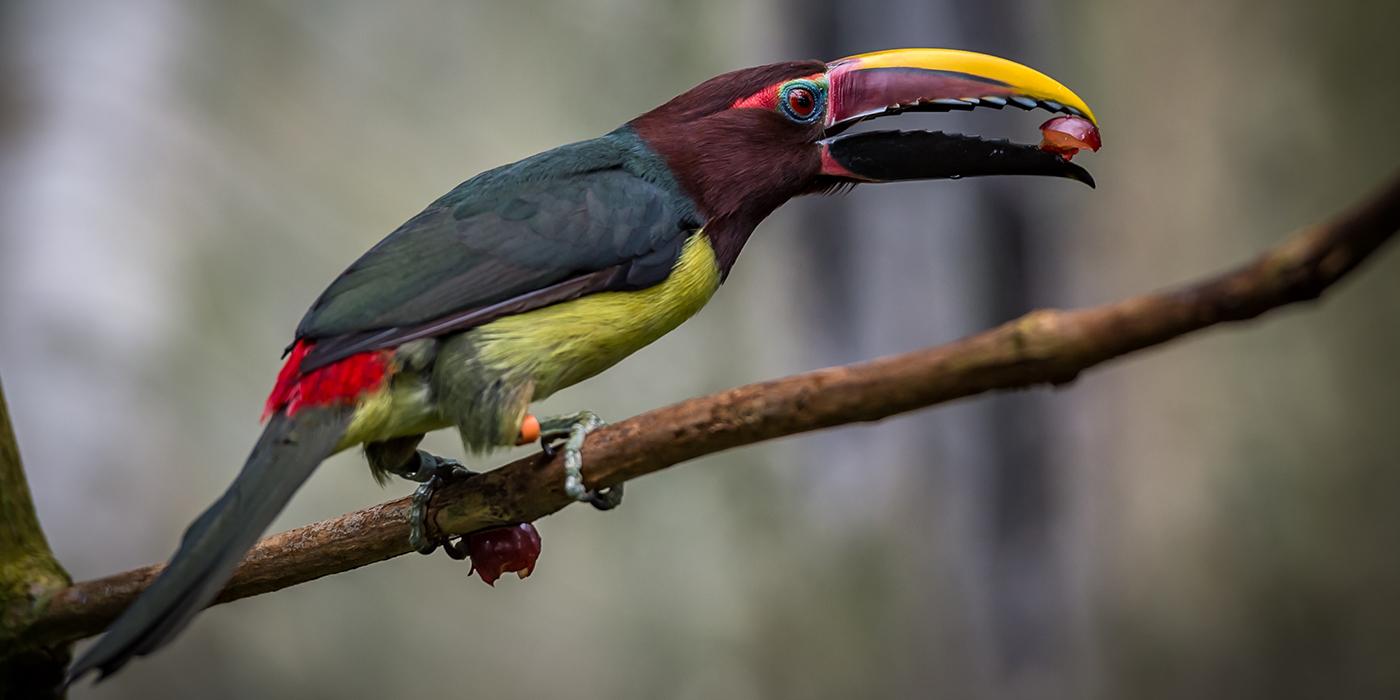
Green aracaris have dark green feathers on their backs, throughout their wings and into their tails. They are sexually dimorphic birds, meaning males and females exhibit some differences in appearance. The male aracari's neck and head feathers are very dark, whereas the female aracari has dark red to brown coloration. These birds have a brightly colored red, yellow and blue bill with a unique serrated edge. Their bill is more deliberately hooked at the end than the bill of other aracaris.
Size
Native Habitat
Green aracaris inhabit tropical forests in northeast South America, specifically Brazil, French Guiana, Guyana, Suriname and Venezuela.
Communication
These birds spend the majority of their time living in small groups in the tree canopy and levels below where they forage together for food. They vocalize during mating rituals and to warn of danger.
Food/Eating Habits
Green aracaris eat fruits, insects, nuts, eggs and small animals. At the Smithsonian's National Zoo, they receive a balanced diet of bird pellets, fruit and cooked sweet potatoes.
Reproduction and Development
Rather than excavating its own hole to build a nest, the green aracari will take over an abandoned woodpecker hole. These existing nesting spots are usually high up in trees. The female will lay two to four eggs and incubate them for 16 to 19 days. Chicks fledge, or develop the feathers they need to fly, about five weeks after hatching. However, the parents will continue to feed the chicks until they are around 6 to 8 weeks old.
Conservation Efforts
The International Union for Conservation of Nature has classified green aracaris as a species of least concern on the Red List, as of a 2016 analysis. The IUCN notes that there has been a decline in green aracari populations, but it is not severe enough to warrant a status change to "vulnerable" on the Red List.
Green aracaris are also listed under CITES Appendix II and are managed under a Species Survival Plan within institutions accredited by the Association of Zoos and Aquariums. Green aracaris are threatened by habitat destruction, due to deforestation of the Amazon rainforest.
Help this Species
Reduce, reuse and recycle — in that order! Cut back on single-use goods, and find creative ways to reuse products at the end of their life cycle. Choose recycling over trash when possible.
Be a smart consumer. Choose products made with sustainable ingredients, such as Smithsonian certified Bird Friendly coffees, which support farmers striving to limit their impact on wildlife and habitat.
Smithsonian's National Zoo and Conservation Biology Institute. (n.d.). Green aracari. Retrieved September 16, 2026, from https://nationalzoo.si.edu/animals/green-aracari
Animal News

Happy 5th Birthday, Qing Bao ›
To celebrate giant panda Qing Bao's birthday, keepers went "far out" and created a 1970s-themed fête full of bright colors and iconic pop culture slogans.

See These 5 New Animals at Your Next Visit to the Smithsonian's National Zoo ›
From a spunky new sloth to a dazzling electric eel, get ready to meet the newest residents making themselves at home.

Happy 50th 'Zooniversary' to Chyna and Rulon, the Zoo’s Aldabra Giant Tortoises ›
There are plenty of objects and artifacts at the Smithsonian that are old. But at the National Zoo, there's not much older than Rulon and Chyna.