
Happy Amphibian Week 2026

Have you ever strolled past an animal’s enclosure at the Zoo, thinking it was empty? Chances are, you were fooled by a creature whose camouflage allows it to seamlessly blend into its environment. Many of these “masters of disguise” are amphibians—animals that live part of their lives in the water, and part of their lives on land.
From frogs and toads to newts, salamanders and caecilians, amphibians have some of the most amazing adaptations and abilities in the animal kingdom. This Amphibian Week, take a closer look at what makes these species so wonderfully weird and worthy of our attention.
Join the celebration onsite and online! Don’t miss the Amphibian Week event at Reptile Discovery Center on Sunday, May 3. And, tune into our Discovering Amphibians webinar May 6 at 2 p.m. Let’s dive in!
May 3 | Streamy Sunday
Located in the heart of the Panamanian rainforest, the Panama Amphibian Rescue and Conservation Project (PARC) exists to protect rapidly vanishing tropical frogs. Frogs endangered by a deadly fungal disease are brought to these shipping-container habitats where our scientists help them breed until they can be safely released—ensuring these unique frogs will be here for future generations.
How do frogs become infected? The chytrid fungus starts out as a swimming zoospore — think of it like a microscopic tadpole. It smells out the frog’s skin, burrows into it, and begins to grow.
A frog’s skin is unique. Unlike our skin, which acts like a barrier, frog skin is much more permeable to the environment. When the chytrid fungus infects the frog’s skin, it mucks up its ability to drink, exchange ions and function properly.
For frog species that are not resistant to this disease, it infects their skin and ultimately leads to a heart attack, killing them. When that spore has fed off of the frog, it will produce its own fruiting body, and the cycle begins again.
Smithsonian scientists at the National Zoo and Conservation Biology Institute and Tropical Research Institute, along with global partners, are working around the clock to find solutions to the chytrid crisis.
Although eastern newts are aquatic as larvae and adults, juveniles (called red efts) live on land! Around 2 to 5 months of age, their lungs, legs and eyelids make them more suited to life on land. As they search for water, they make their homes in leaf litter along the way.
May 4 | Mucky Monday
We're in luck here, down in the muck here! Seasonal rains create vernal pools—shallow, natural forming ponds. Many frogs, toads, salamanders and newts use these temporary habitats to breed and find new homes. Because these wetlands are woven into the life cycles of amphibians, the absence of a vernal pool can result in fewer frogs, toads and salamanders in that area.
Vernal pools only hold water for a portion of the year. While amphibian eggs may be safe from fish in this habitat, other amphibians like red-spotted newts, or even reptiles like snapping turtles, will forage in a vernal pool and snack on newly laid eggs.
Hundreds of species of microorganisms—including fairy shrimp, daphnia and insect larvae—live in vernal pools year-round. Many of these tiny animals have the ability to go dormant (physically slow down) when the wetland dries in late summer and re-awaken when the pool fills in springtime—just in time to be eaten by those hatching tadpoles and froglets.
Amphibians are critical to the food chain; healthy population of amphibians keeps insect populations in check, and larger animals rely on these amphibians as their food sources. Balanced animal populations keep forests healthy, and forests benefit all life on Earth.
May 5 | Around Town Tuesday
In the Reptile Discovery Center’s Jewels of Appalachia exhibit, visitors can peer into the underground world of salamanders and learn about how these tiny creatures are critical to an entire ecosystem, as well as what Smithsonian Conservation Biology Institute scientists are doing to save them. In this virtual keeper chat, get tips on how to spot our Appalachian salamanders from Reptile Discovery Center keeper Sara Hasenstab!
Salamanders are as American as apple pie. The Appalachian ecosystem is home to more salamander species than any other region on the planet. Of the estimated 600 salamander species in the world, one-third are found in the United States—half of which live in Appalachia.
In Virginia, there are 54 species alone! One of the rarest species is the Shenandoah salamander, which is only found on three mountain peaks in Shenandoah National Park—located within an hour’s drive of the Zoo.
The biomass of all the red-backed salamanders alone would outweigh all of the deer in Appalachian forests. This abundance of salamanders means that they are helping to keep invertebrate populations in check. Their waste, too, helps contribute nutrients to the soil.
Keepers’ Advice for Spotting “Jewels of Appalachia” Salamanders
Because salamanders are nocturnal, the best time to see them up and about at the Reptile Discovery Center is early in the morning and around dusk. Generally-speaking, our salamanders tend to hide in the dark crevices of their exhibit. Be patient and look closely at areas that are mossy and damp—those are the salamanders’ favorite spots.
When scientists are trying to conserve a species, it's critical for them to know how many of those animals are living in the world. But when you're considering creatures like red-backed salamanders — which spend a lot of time underground — how would you try to count them?
It turns out, you need tiny "tattoos" and a lot of hands.
By counting the ratio of marked to unmarked salamanders in a designated plot, researchers can determine how many salamanders are in an entire forest! The Smithsonian is part of the Salamander Population & Adaptation Research Collaboration Network (SPARCnet), a group of scientists and educators that studies how different salamander populations are faring across North America. Together, SPARCnet monitors how climate change and land use may impact salamanders.
May 6 | Wetland Wednesday
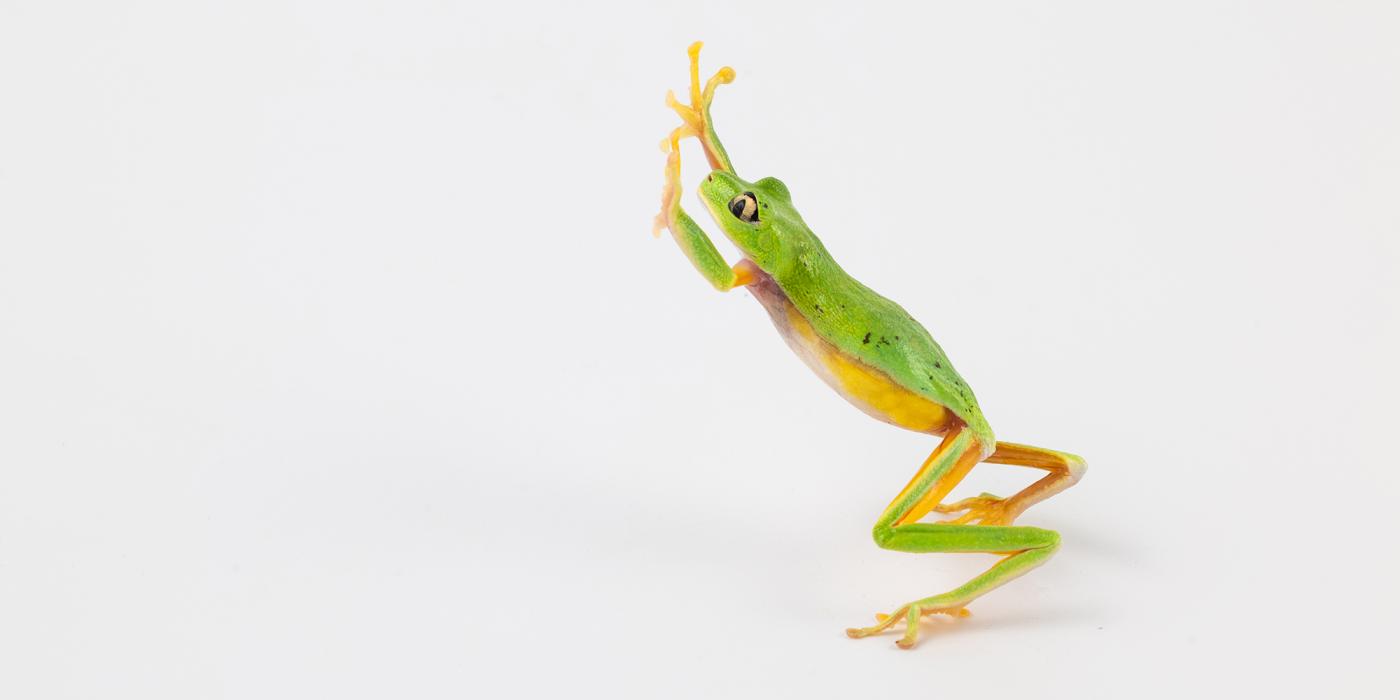
As researchers prepared to release the endangered lemur leaf frog back into the forests of Panama, they had to think outside the box about how to give the animals the best chance at survival. Rather than putting adult frogs into the forest, they are putting tadpoles into soft release containers known as mesocosms. Some of the tadpoles received anti-fungal treatments to see whether early protection helps the tadpoles survive disease once they metamorphose into adult frogs.
This research is part of the Tropical Amphibian Research Initiative (TARI) and is made possible with support from the Bezos Earth Fund.
When a group of Panamanian farmers told Smithsonian researchers that they had cool frogs on their property, they weren’t kidding! The farmers had discovered a new, healthy population of Colostethus pratti, also known as the Pratt’s rocket frog. Scientists carefully relocated some of those frogs to another region of Panama, where the pratti had disappeared due to the deadly amphibian chytrid disease.
In June, Scientists placed 24 of the pratti into soft-release pens to help them acclimate to their new homes before releasing them into the wild. After just a few days, the frogs started breeding and laying eggs, signs that bode well for this species’ future in Panama!
This research is part of the Tropical Amphibian Research Initiative (TARI) and is made possible with support from the Bezos Earth Fund.
May 7 | Terrestrial Thursday
If you build it, they will call!
When coronated tree frogs are ready to mate, the male will locate a water filled tree cavity and begin calling to nearby females. If the female chooses him, she will lay her eggs in the pool. As Smithsonian scientists prepared to release frogs bred under human care to the wild, the team wondered if they could improve the likelihood of the frogs breeding after release. They built artificial tree holes made of different materials to test which, if any, the frogs preferred.
Once released, the frogs began exploring their new homes immediately and soon were calling to their neighbors. Knowing what types of tree holes the frogs prefer makes it possible for scientists to help the frogs acclimate to the wild. Researchers will decide if installing more artificial breeding sites could help bolster wild populations. This research also tells the team what kind of tree holes should be built when breeding the frogs under human care.
This research is part of the Tropical Amphibian Research Initiative (TARI) and is made possible with support from the Bezos Earth Fund.
May 8 | Freaky Friday
Meet the GIANTS of the amphibian world: Japanese giant salamanders! These tough and resilient salamanders can get up to 5 feet long and weigh 55 pounds.
In the wild, Japanese giant salamanders primarily feed on fish and crustaceans, as well as smaller amphibians. Since they cannot see well, they count on their sensory organs to hunt. Their bodies are covered in bumpy tubercles that help them sense their way around and pick up on the movement of prey.
Meet one of our Japanese giant salamanders, Hiro, and Reptile Discovery Center keeper Kyle Miller in this virtual animal demo!

Some salamanders can give you a hand—and grow theirs back. One of the coolest things about salamanders is that most of them have the ability to regenerate body parts—including limbs, tails, eye tissue and even brain tissue.
By studying how the salamanders’ macrophages are able to repair and regenerate so effectively, scientists can take what they learn and apply it to human medicine. In future, what we learn could help those who have lost limbs or are battling Alzheimer’s disease.
May 9 | Sandy Saturday
With a sleek, eel-like body and beady eyes, the aquatic caecilian is quite an unusual amphibian. They look like a cross between a snake and an eel, but they are neither. Just like frogs and salamanders, caecilians are amphibians. They are native to the Amazon River Basin in South America and spend their entire lives in the water.
There are some key differences between caecilians and other species of amphibians. Many amphibians can exchange oxygen through their skin via a specialized membrane, but caecilians do not. Their skin is quite thick, and they must come to the surface to take breaths of air. Juveniles take breaths more frequently, about every five to 10 minutes. Adults, however, can hold their breath between 20 to 30 minutes at a time.
Want to help amphibians? Pay attention to where the goods you purchase come from. When you avoid goods that are produced by excessive agricultural practices (such as clear-cutting of forests), you help preserve the sensitive habitats amphibians call home.
I want to help amphibians! What can I do?
Saving amphibians takes a dedicated animal care team, cutting-edge conservation research and people like YOU! Get tips on how to help frogs, toads, salamanders, newts and caecilians from our experts. Hop to it!
Keep habitats clean. Protecting amphibians means protecting water in our neighborhood. They need pristine conditions to thrive. When caring for your home and lawn, use pesticides and fertilizer sparingly. Excess chemicals can runoff into local waterways and inadvertently make amphibians and the insects they eat ill.
Reduce, reuse, recycle. Every little bit makes a big difference for wild animals and their habitats, here and abroad.
Know before you buy. Owning a pet is a commitment for the lifetime of that animal. Amphibians require specific—and sometimes costly—environmental, dietary and enrichment needs. If you can provide these, only purchase pets from reputable organizations. Never buy an animal that was taken from the wild.
Take a hike (safely). Between hikes, disinfect your footwear to avoid tracking bacteria and fungi that could be harmful to amphibians.
Volunteer. Classroom education is important, but so is hands-on experience. If you want to work with frogs, consider interning or volunteering at your local zoo or nature center.
Support conservation efforts. Our animal experts study frog biology, reproduction, disease and ecology. When you shop at the Zoo or make a donation, your dollars support our efforts to save these animals and their habitats.
Get involved in community science. Catalogue the wildlife you see and record that information for scientists studying them in the wild.
Share their stories. Tell somebody how excited you are about amphibians, and get them to be excited, too!
Continue Exploring
Happy Amphibian Week 2025
This Amphibian Week, take a closer look at what makes these species so wonderfully weird and worthy of our attention.
'Hoppy' Amphibian Week!
This Amphibian Week, take a closer look at what makes these species so wonderfully weird and worthy of our attention.
Amphibian Awareness Week 2023
'Hoppy' Amphibian Awareness Week! All week long, the Smithsonian's National Zoo and Conservation Biology Institute will be sharing stories about amazing amphibians and the scientists working to save them from extinction.