
Physical Description
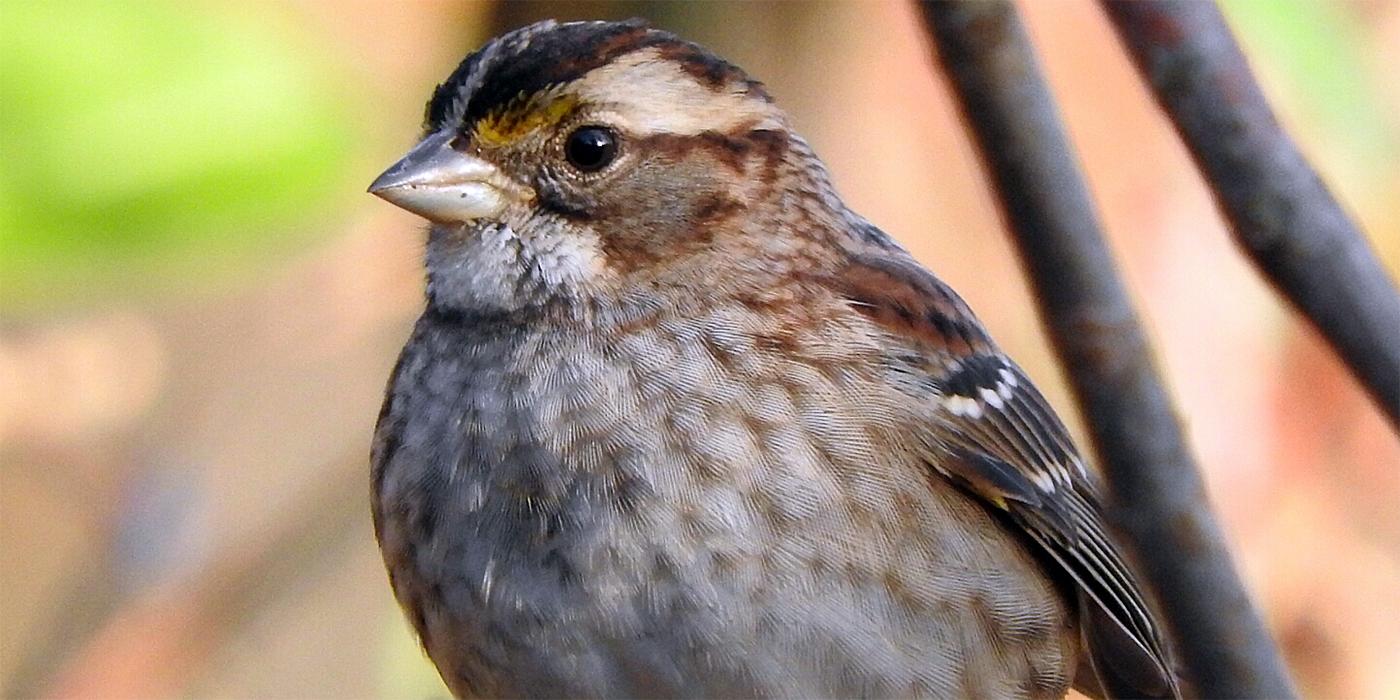
Yellow lores (the area between the eye and beak) and white throats mark them as distinct from other sparrows. Beyond those markings, there are two distinct forms of white-throated sparrows. One form, the tan-striped, has a dark brown crown with a tan central stripe, while the other form black and white stripes.
Size
White-throated sparrows measure 6 to 7.5 inches (15 to 19 cm) long.
Native Habitat
During the summer breeding season, white-throated sparrows live in forests, either evergreen or deciduous. In winter, they prefer the edges of woodlots, thickets, fields, suburbs, backyards and parks.
White-throated sparrows spend their summers from New England into Canada. Most overwinter in the eastern United States
Lifespan
Communication
The white-throated sparrow’s song is typically written as “O-oh sweet Canada, Canada, Canada”.
In 2020, bird scientists discovered that a new form of white-throated sparrow song had emerged and was spreading east from British Columbia. In it the triplets are replaced with doublets, so it would be more like “O-oh sweet cheery, cheery, cheery”.
Food/Eating Habits
Like other sparrows, white-throated sparrows forage on or near the ground, eating mostly seeds, berries and insects. They love backyard bird feeders, especially millet and sunflower seed. In the breeding season, they eat more insects, including damselflies, ants, wasps, beetles, flies, caterpillars, spiders and snails. In the winter they eat mainly seeds, berries and grasses.
Social Structure
Reproduction and Development
Males usually return to the summer breeding grounds first. They seek out and defend territories by singing before the females arrive.
White-throated sparrow pairs sometimes consist of one white-striped form and one tan-striped form; each forms have different reproductive strategies. Tan-striped males help raise their chicks and defend their mates from other males, while white-striped males try to mate with as many females as possible, without helping much (or at all) with parental care. Tan-striped females similarly stick close to home, while white-striped females seek out extra-pair mates and lay their eggs in another birds’ nest.
They typically nest on or near the ground. The females build the nests, working mainly in the mornings. She finds a shallow natural bowl in the ground and builds up the sides with moss and with grass, wood chips, pine needles and twigs. She lines it with fine grasses, rootlets, and mammal fur.
The female lays one to six eggs, which hatch in 11 to 14 days. The chicks fledge 7 to 12 days later.
Conservation Efforts
Help this Species
Be a smart consumer. Choose products made with sustainable ingredients, such as Smithsonian certified Bird Friendly coffees, which support farmers striving to limit their impact on wildlife and habitat.
Be a responsible cat owner, and keep cats indoors or under restraint when outside. Never release animals that have been kept as pets into the wild.
Conservation starts with you! Join a citizen science project where you can help collect valuable data for scientists. Encourage your friends and family to get involved too.
Plant native flowers in your garden to help feed resident and migrating pollinators. You'll make your lawn beautiful and help wildlife at the same time!
Smithsonian's National Zoo and Conservation Biology Institute. (n.d.). White-throated sparrow. Retrieved September 15, 2026, from https://nationalzoo.si.edu/animals/white-throated-sparrow
Animal News

Happy 5th Birthday, Qing Bao ›
To celebrate giant panda Qing Bao's birthday, keepers went "far out" and created a 1970s-themed fête full of bright colors and iconic pop culture slogans.

See These 5 New Animals at Your Next Visit to the Smithsonian's National Zoo ›
From a spunky new sloth to a dazzling electric eel, get ready to meet the newest residents making themselves at home.

Happy 50th 'Zooniversary' to Chyna and Rulon, the Zoo’s Aldabra Giant Tortoises ›
There are plenty of objects and artifacts at the Smithsonian that are old. But at the National Zoo, there's not much older than Rulon and Chyna.